
Wairere Drive: Long road to Māori recognition
Enlarge
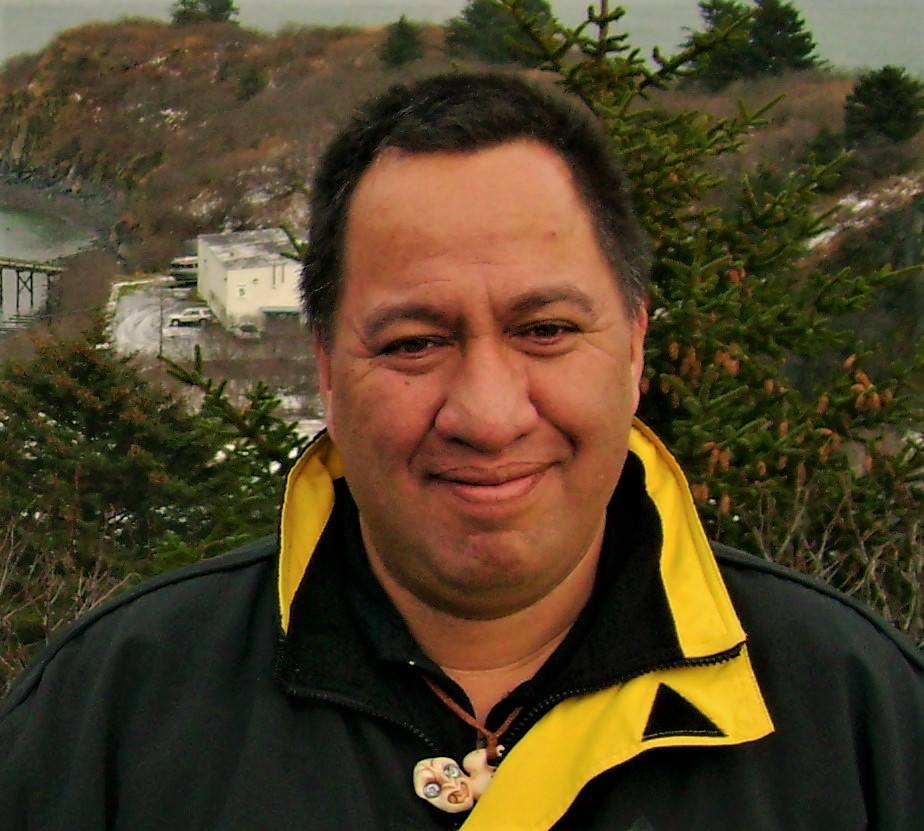
Ngāti Wairere historian Wiremu Puke pushed for Mana Whenua recognition in the naming of Hamilton's multi-million dollar ring road, Wairere Drive. Photo: Supplied.
Wiremu Puke of Ngāti Wairere has battled for pre-European acknowledgement in Kirikiriroa (Hamilton). At Hukanui Marae on October 4, he spoke about the journey to naming a multi-million dollar expressway and other subsequent roads.
Wairere Drive is a major arterial road with four lanes, multiple bridges and accommodates both pedestrians and cyclists, as well as cars, and is projected to meet the growing traffic demands of Hamilton. The Crosby Road to Fifth Avenue section was opened in 2012 by Mayor Julie Hardaker and the blessing was offered by Wiremu and his aunt, Ngāti Wairere Kuia Hekeiterangi Broadhurst.
Puke was “inspired” to push for names of significance because of his mother’s rohe—Turangi.
All the streets in Turangi are named after the whakapapa of Ngāti Turangitukua so that inspired me, gave me the impetus to push for Wairere Drive
“Also my father [Hare Puke (1925-2008)] was the kaumātua of the city at the time so I pushed it through the media and he pushed it at a political level.”
Enlarge
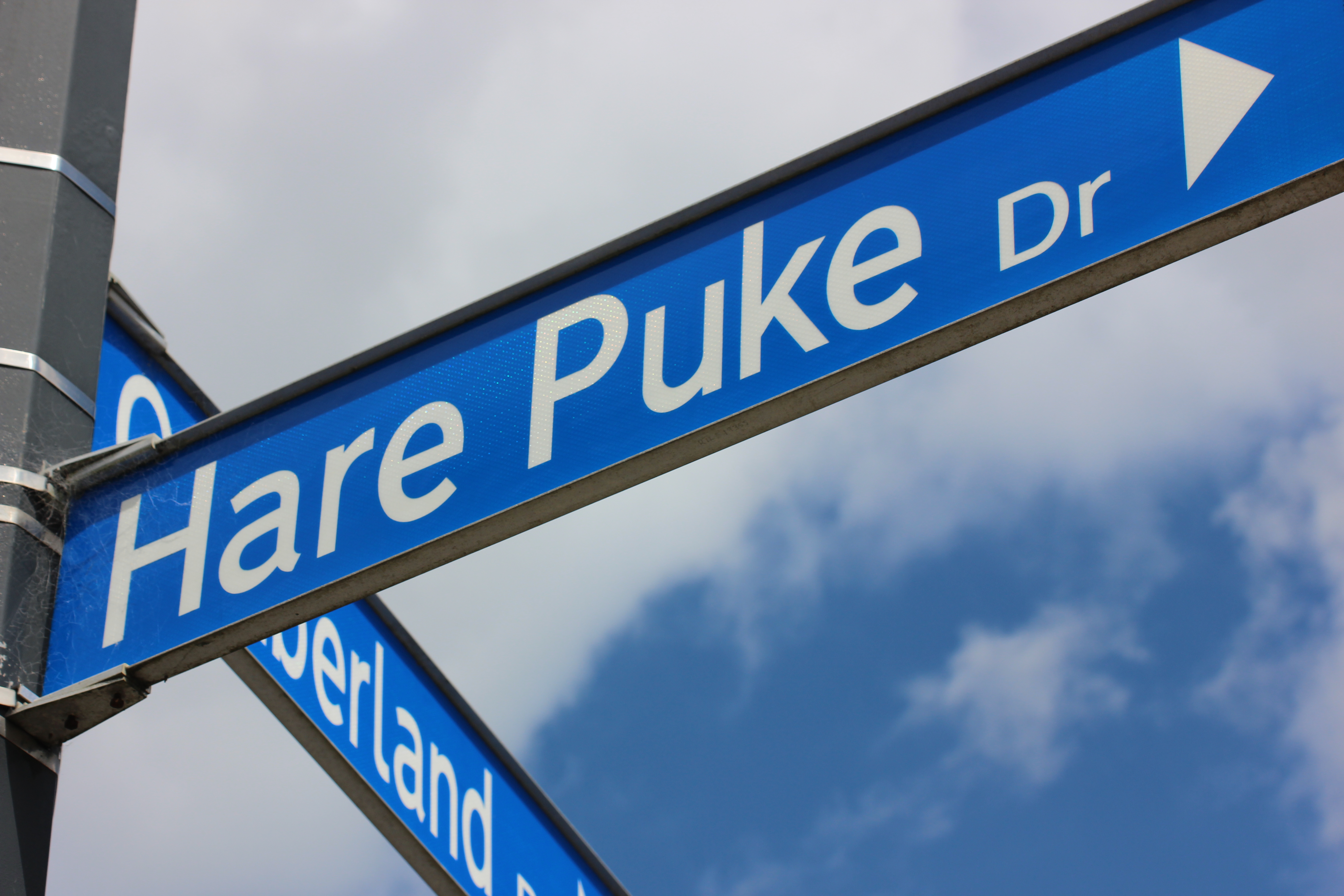
Hare Puke Drive is located in Flagstaff and was named after Wiremu's father. Hare Puke passed in 2009. He was a senior kaumātua to the Hamilton City Council and was involved with the landmark Tainui Raupatu settlement (1995). Photo: Horiana Henderson
“Of all the Māori names there were only about two or three that were relevant or historically correct.”
A recognised historian of the area, Puke says there are long-standing errors in the way some places are named.
“Kirikiriroa Gully is in Chartwell but Kirikiriroa Pa was located between London Street and Bryce Street; Te Rapa was by the Waikato Hospital and Cobham Drive; and Horotiu is actually located in present day Cambridge.”
“So as a hapū we suffered place names that were put in the wrong localities by surveyors that came in here immediately after the [1863] Land Wars.”
Auckland Professor Giselle Byrnes has referred to survey activity in colonial New Zealand as “colonising by language”.
Christine Whybrew’s Journal on Dunedin photographers, The Burton Brothers, discusses Byrnes’ analysis and says:
The assigning of place names was a particularly potent statement of colonialism, imposing statements of power and possession, as well as ‘assertions of presence and signifiers of occupation’
Puke said: “What you’re perpetuating is another form of colonisation.”
In 1881, the people of Parihaka, near New Plymouth, passively resisted the confiscation of their lands. This was acknowledged by the New Zealand Government in June 2017.
John Bryce, who became known by Taranaki Māori as “Bryce Kohuru” (“Bryce the Murderer”), supervised the destruction of the settlement and the imprisonment of their prophets, Te Whiti-o-Rongomai and Tohu Kākahi, for 16-months without trial.
Enlarge
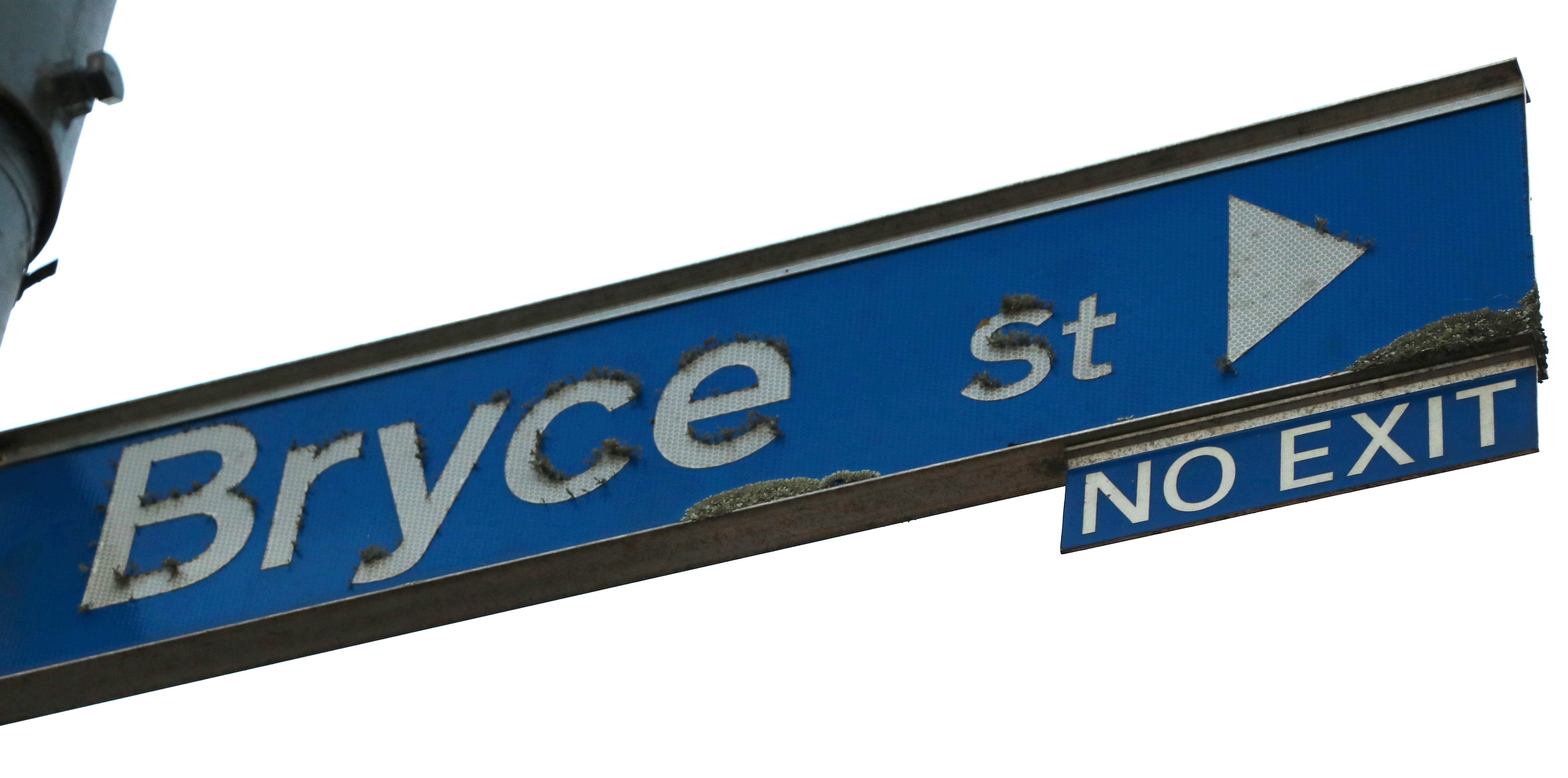
Bryce Street, located in Hamilton's CBD, was named after John Bryce, M.P. for Waikato (1890-91) and Minister of Native Affairs. Photo: Horiana Henderson
Hamilton’s own Bryce Street is named after him.
Puke compared such practices as akin to naming new subdivisions after concentration camps with streets named Hitler, Himler and Goebbels.
“They hated that kind of reasoning,” he said.
But Puke continued to push for recognition and found support.
“I really owe credit to Margaret Evans,” he said.
Three names were put forward for Hamilton’s ring-road in 1995. Margaret Evans, Brian Perry, and Jubilee Drive.
“No-one could figure out what Jubilee was for and I knew Brian and Margaret would say no so those three names were basically taken off the list and Wairere was put forward.”
“As far as I know it went before council and it was just Margaret Evans’ casting vote as the Mayor that it was adopted.”
“When we came out with the history of the significance of the tupuna himself it made sense.”
Enlarge
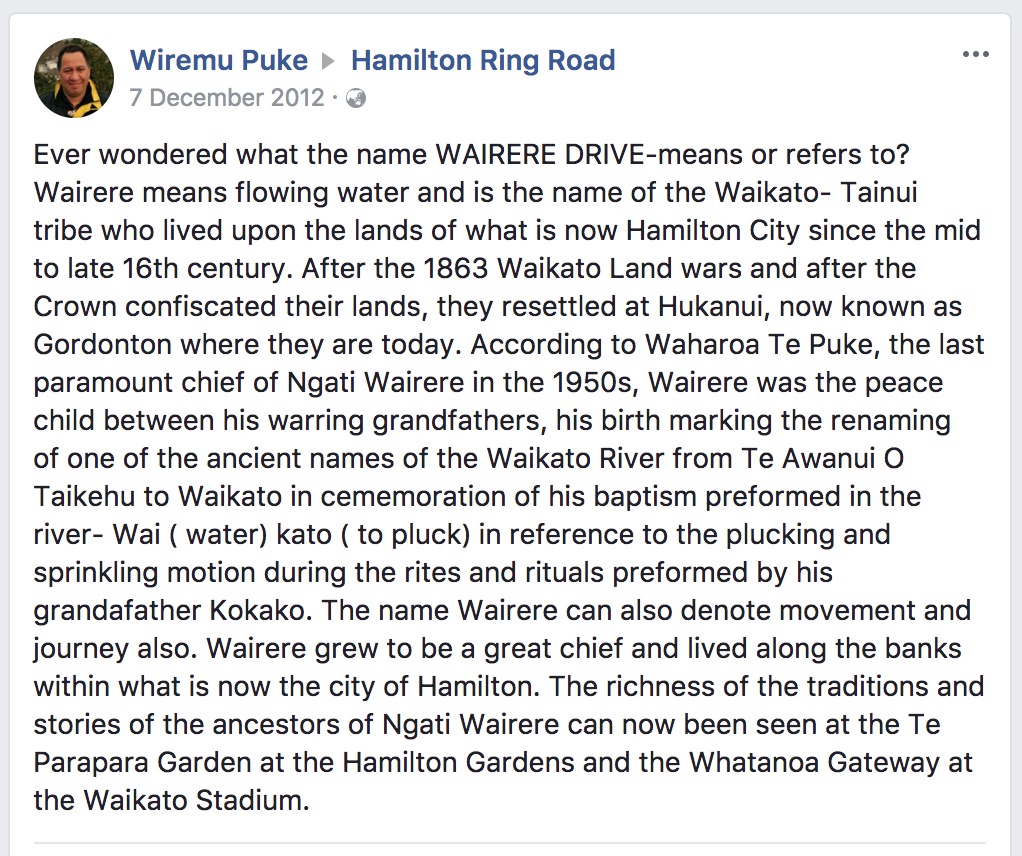
Facebook post: Wiremu Puke (2012)
“It’s not just the fact that the road carries the name of our hapū. It’s that in the face of having to deal with a city that at this time still struggles with its engagement with Māori, it’s good to see an outcome resulting from that time.”
“Auckland doesn’t have Whātua Drive. Christchurch doesn’t have Ngāi Tahu, neither does Wellington have Ngāti Toa or Te Ātiawa.”
“It’s taken a stance and somebody had to do it. It’s a special legacy,” Puke said.
That makes our city stand apart. It's got its Māori name for its main road
Since 1995, Wiremu Puke has put forward several names which hold significance for Ngāti Wairere. Names which have been adopted and were supported by the Nga Mana Toopu O Kirikiriroa Trust and the Hamilton City Council.
The hapū contributed to the naming of Mangaharakeke and Koura Drives and the New Zealand Transport Agency lists them as roads of national significance .
Then PM, John Key opened State Highway 1 Mangaharakeke Drive in 2012.
However, despite the fact that there is ample signage stating its official name, Google Maps currently lists it as “Waikato Expressway” and “SH1 Avalon Drive Bypass”.
Enlarge
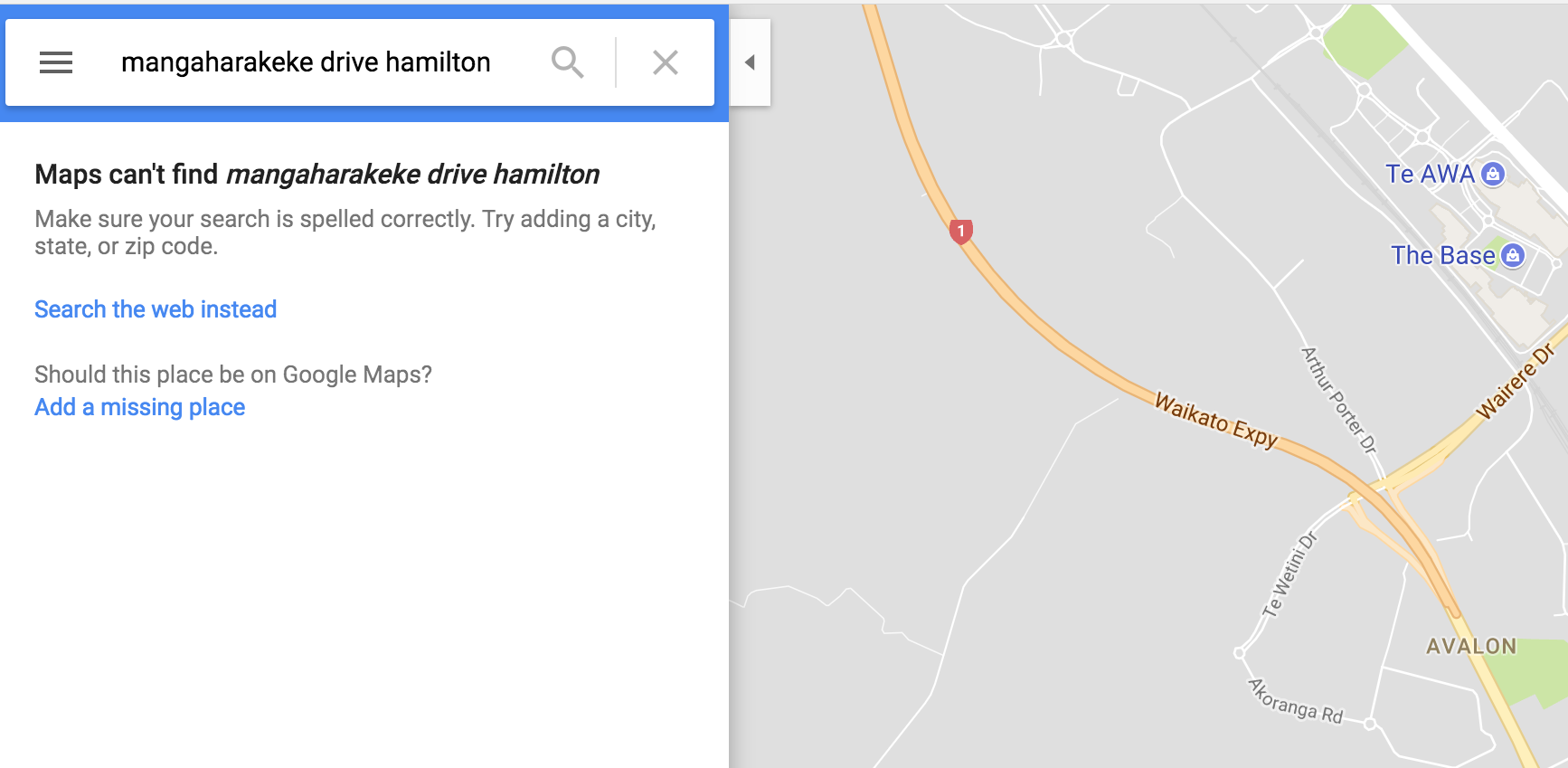
Google maps have not updated Ngāti Wairere contributed street name, SH1 Mangaharakeke Drive, since it was opened by then PM John Key in 2012. Retrieved: November 9, 2017.
Scotsman led Hamilton's first Waikato Wars Commemoration
Enlarge
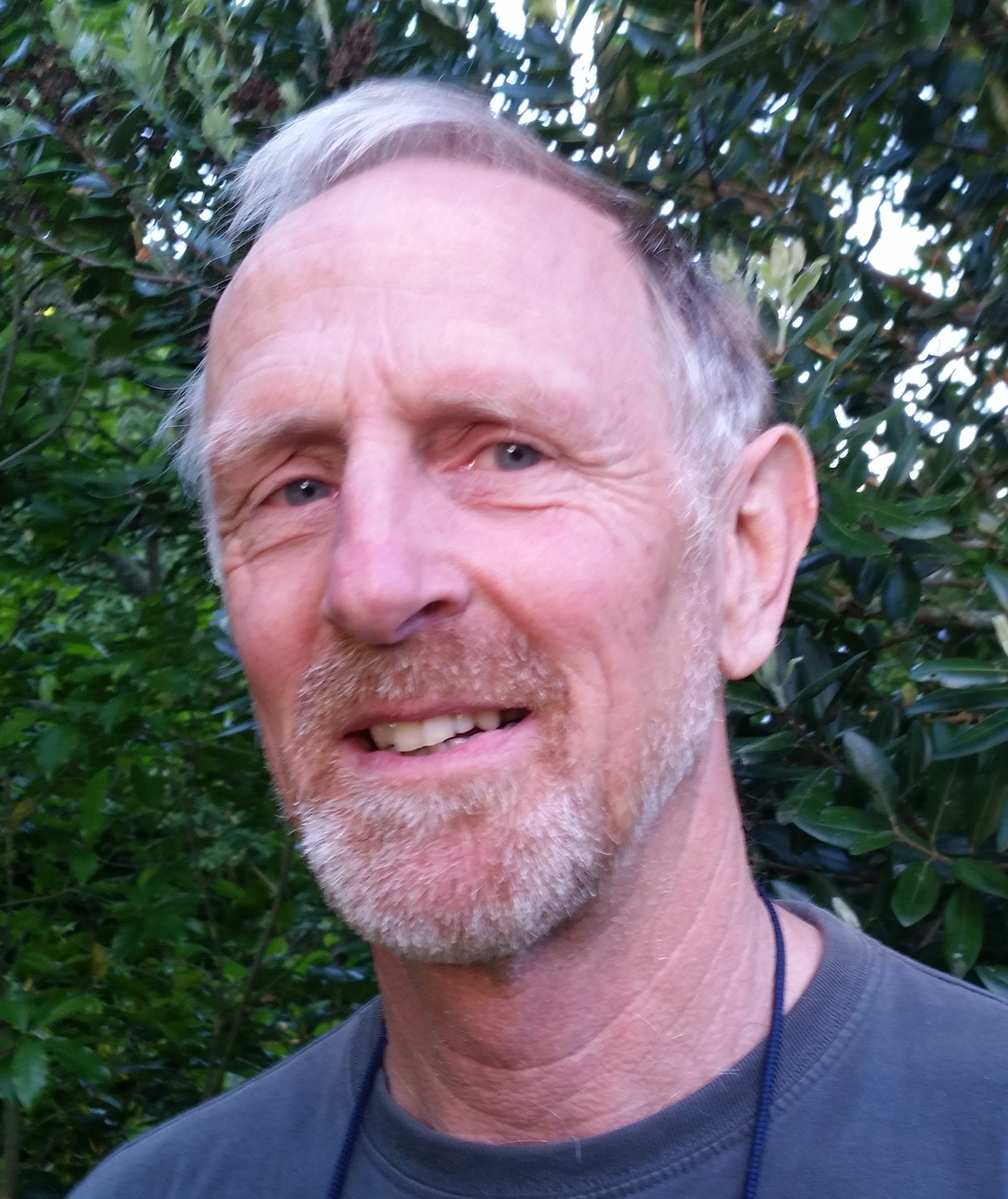
Bruce MacKay's Scottish ancestors' experience of being "kicked out" of Scotland helps him relate to Māori descendants of the 1860s Waikato Land Wars. Photo: Horiana Henderson
When Scottish Hamiltonian, Bruce MacKay discovered that the city would not mark New Zealand’s first official annual Rā Maumahara (Commemoration Day of the New Zealand Wars), he decided to act.
Rā Maumahara came about because Otorohanga College students, Waimarama Anderson and Leah Bell, petitioned the Government to acknowledge the wars and sacrifices made on New Zealand soil.
The girls declared: “Me maumahara tātou (We must remember)” and the date of October 28 was appointed.
Me maumahara tātou
We must remember
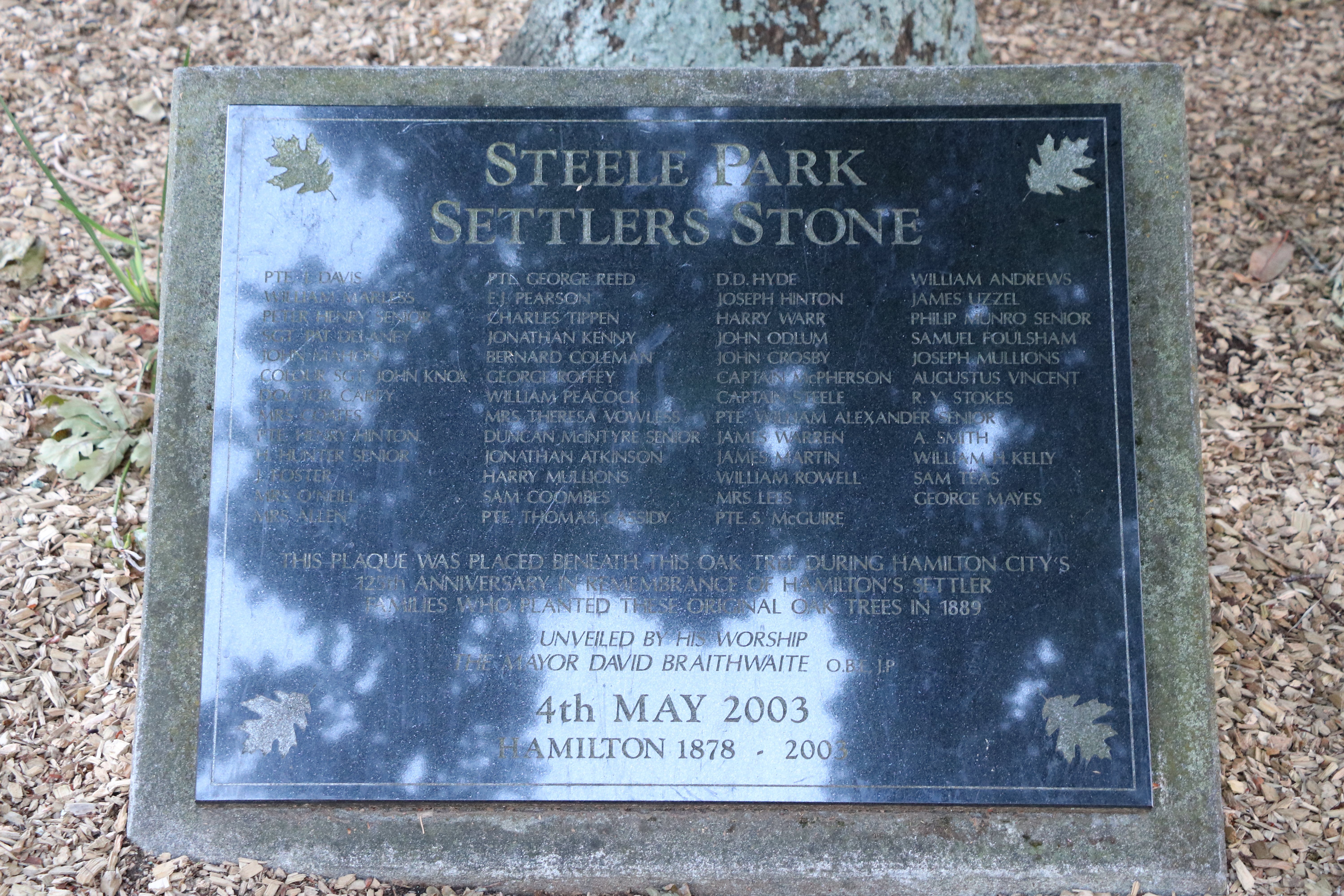
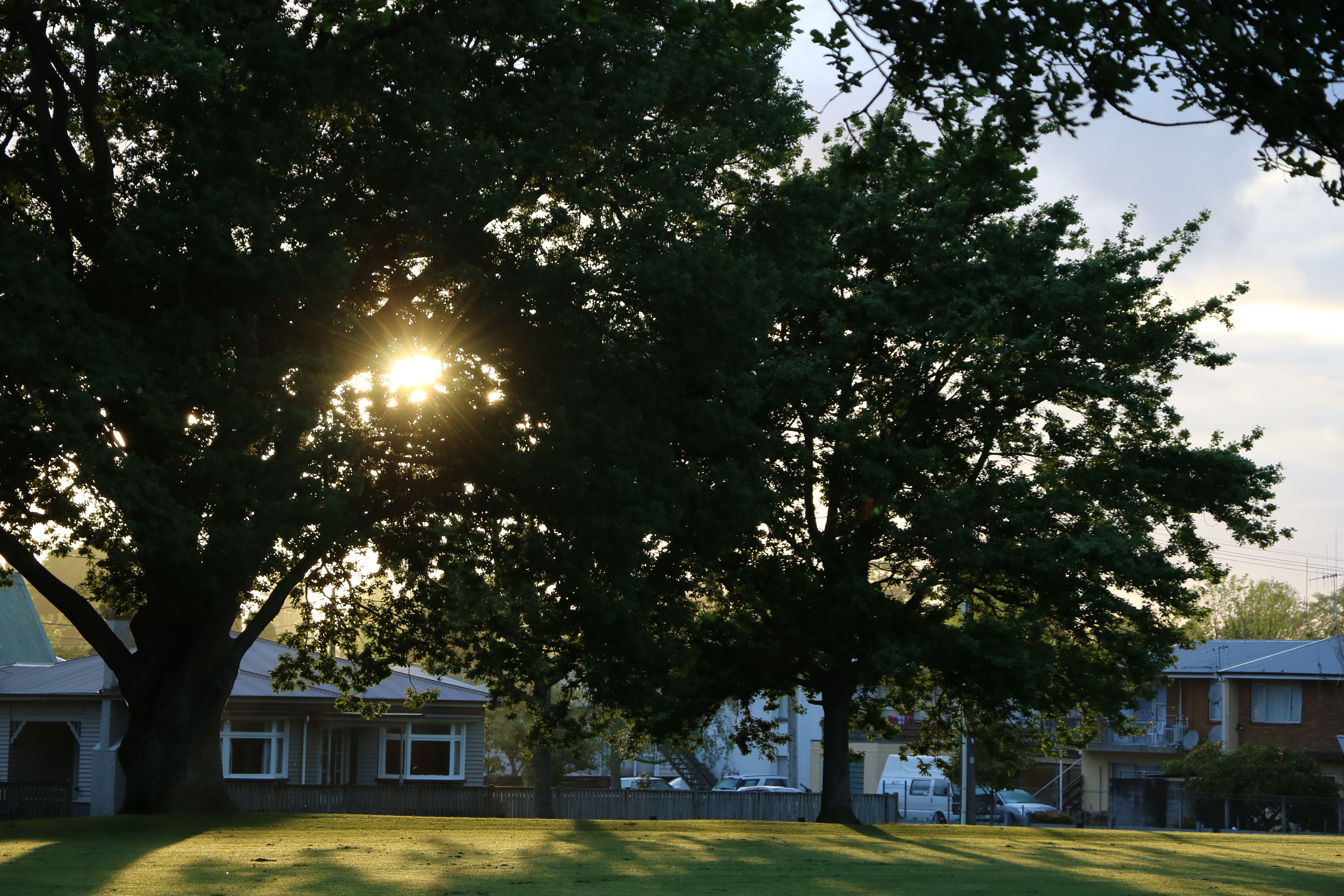
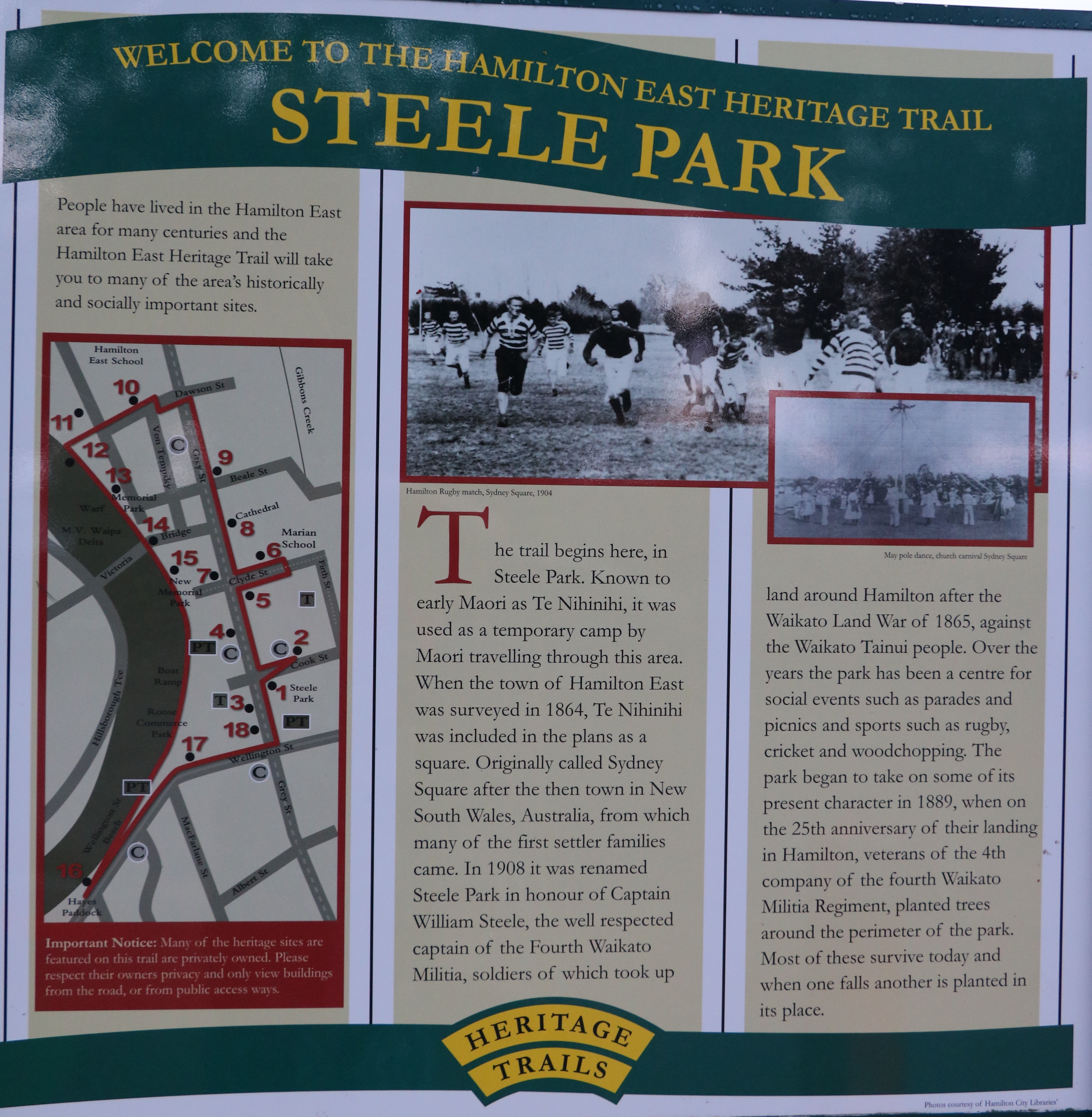
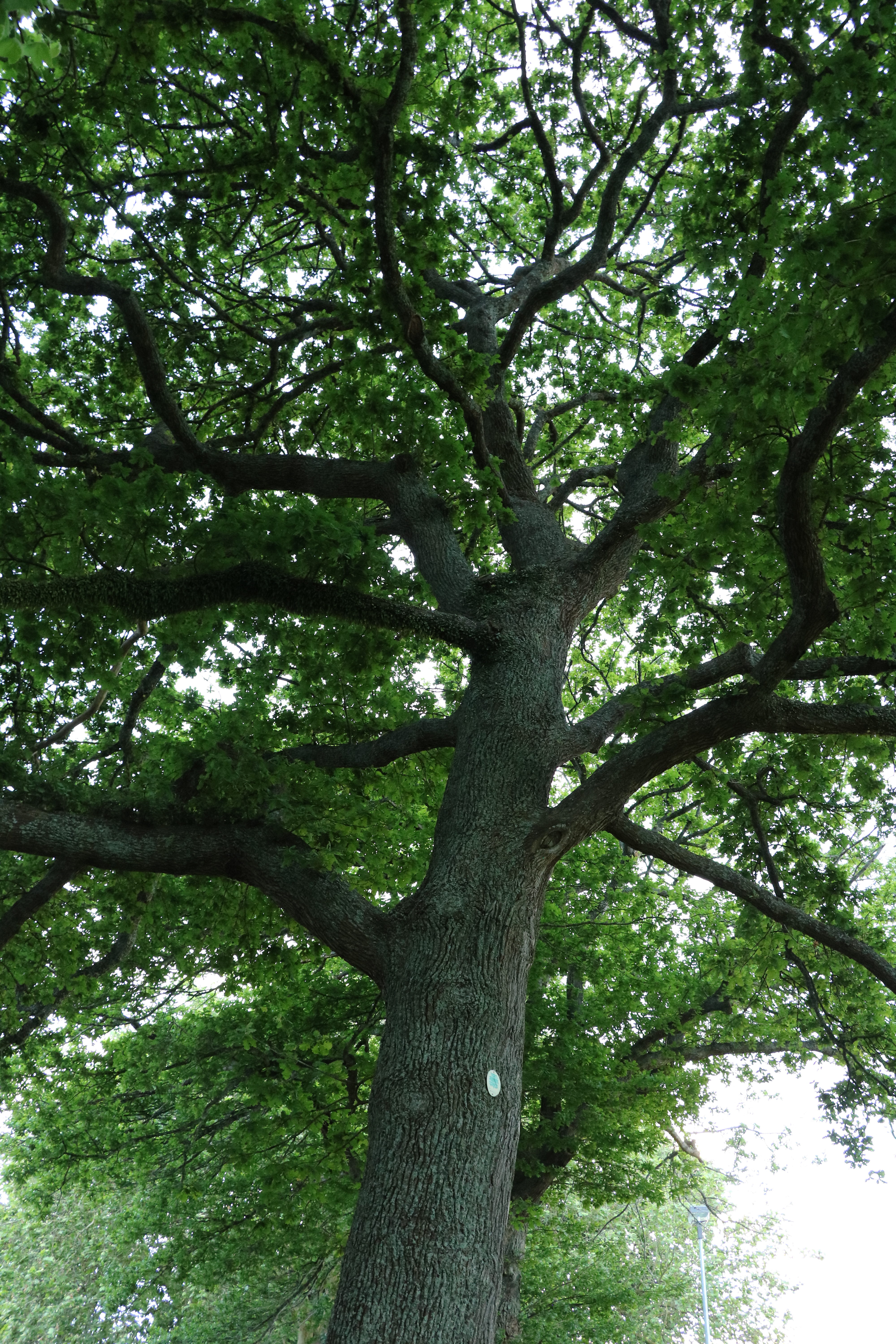
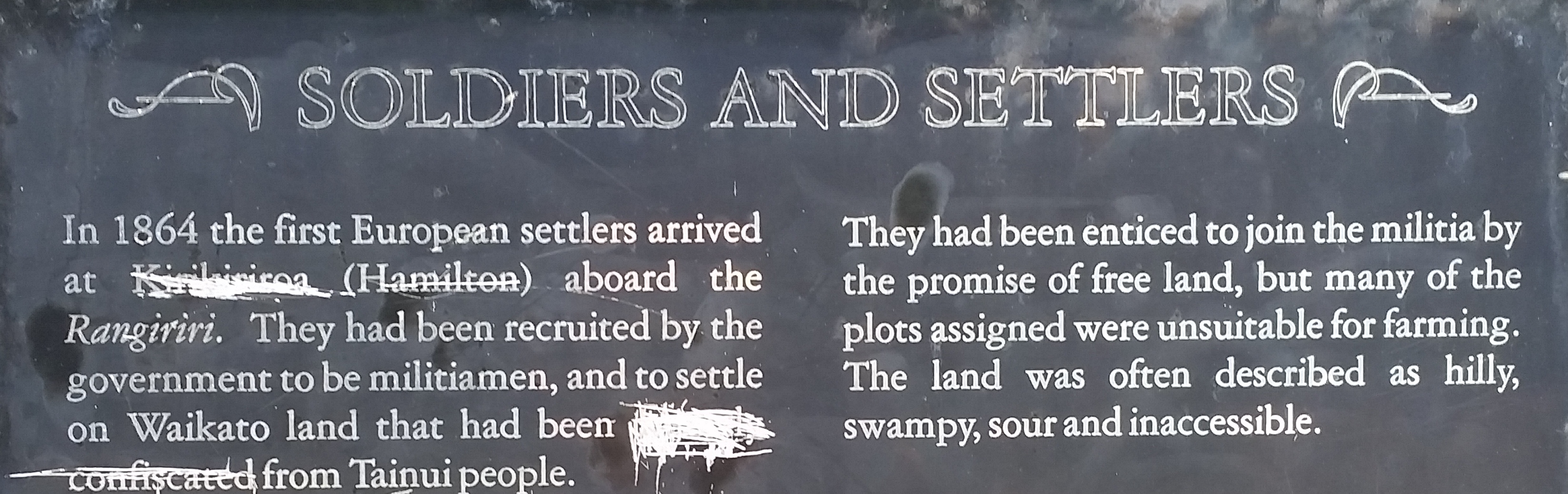
MacKay’s way of remembering was to tie ribbons around Hamilton’s Steele Park (Te Nihinihi) oak trees. The ribbons would commemorate Māori warriors and adorn the oaks which were planted in 1889 and named for the 4th Waikato Militia who claimed Kirikiriroa (Hamilton) in 1864.
The park is named after William Steele, Captain of the gunboat “Rangiriri” that brought the first Europeans to the area.
Prior to the militia’s arrival, Kirikiriroa Pā (between Bryce and London Streets in the Hamilton CBD) had been home to the people of Ngāti Wairere for over 150 years.
They are recognised as Hamilton mana whenua (holders of customary rights over the area by virtue of birthright).
MacKay’s Chartwell residence stands where a former Ngāti Wairere Pā site (Te Inanga) stood and he reached out to Waikato hapū, including Ngāti Wairere, to plan the only Rā Maumahara ceremony to take place in Hamilton.
Enlarge
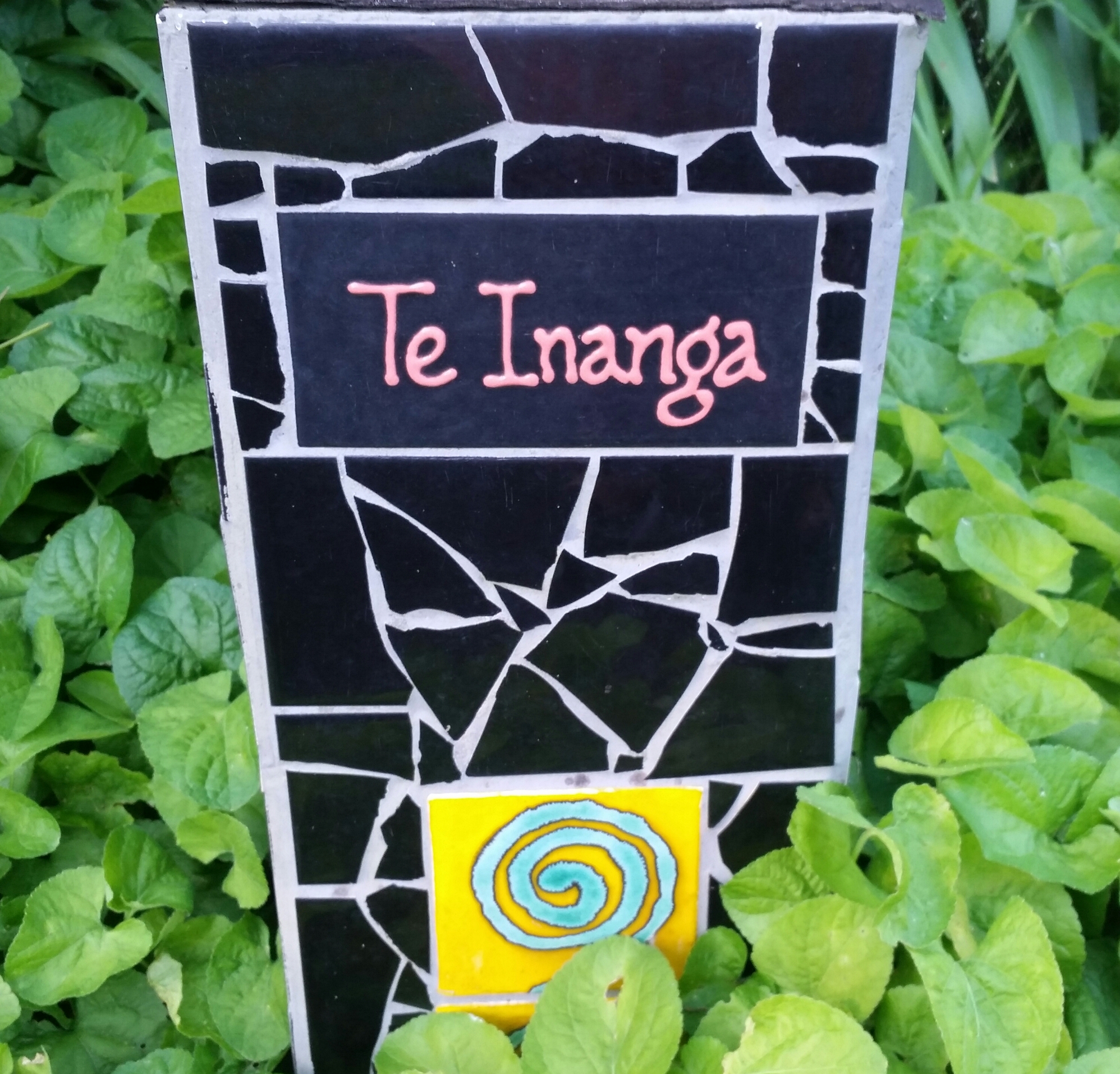
Acknowledging Ngāti Wairere as mana whenua of Kirikiriroa (Hamilton) begins at MacKay's letterbox. Te Inanga is the name of the Ngāti Wairere Pā that once stood on his Chartwell property. Photo: Horiana Henderson
He spoke from home on November 6, about his designs to effect commemoration for Māori in the city.
Two of his uncles were deployed for the Great World Wars but he feels that commemoration for local battles pale in contrast to off-shore observances.
An Armistice Day ceremony and the unveiling of the World War One War Horse statue named “Gunner” was held at Hamilton’s Memorial Park on River Road 14-days after Rā Maumahara on November 11.
The Mayor, Andrew King, with various dignitaries from the military to community groups was in attendance along with a considerable crowd.
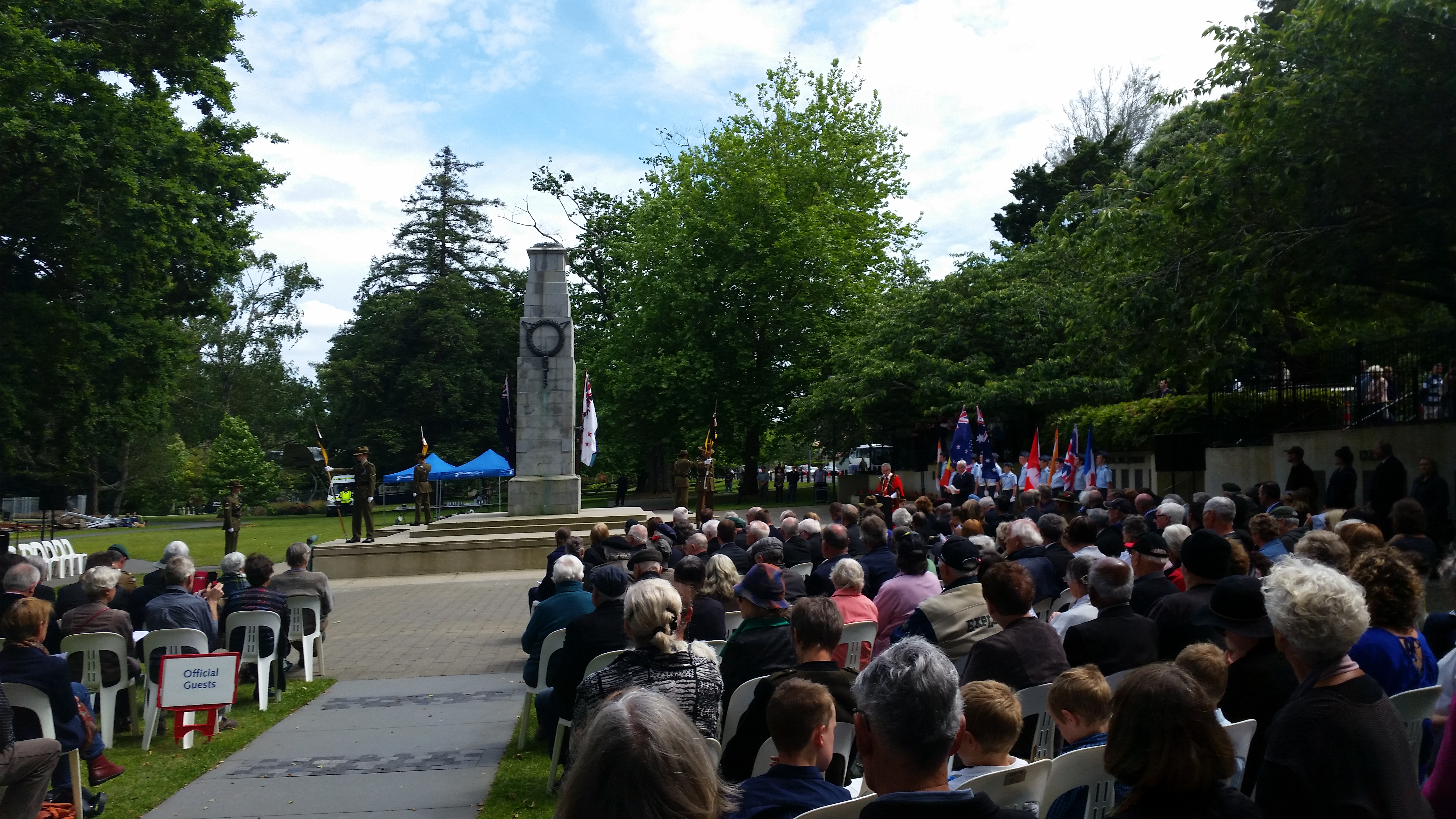
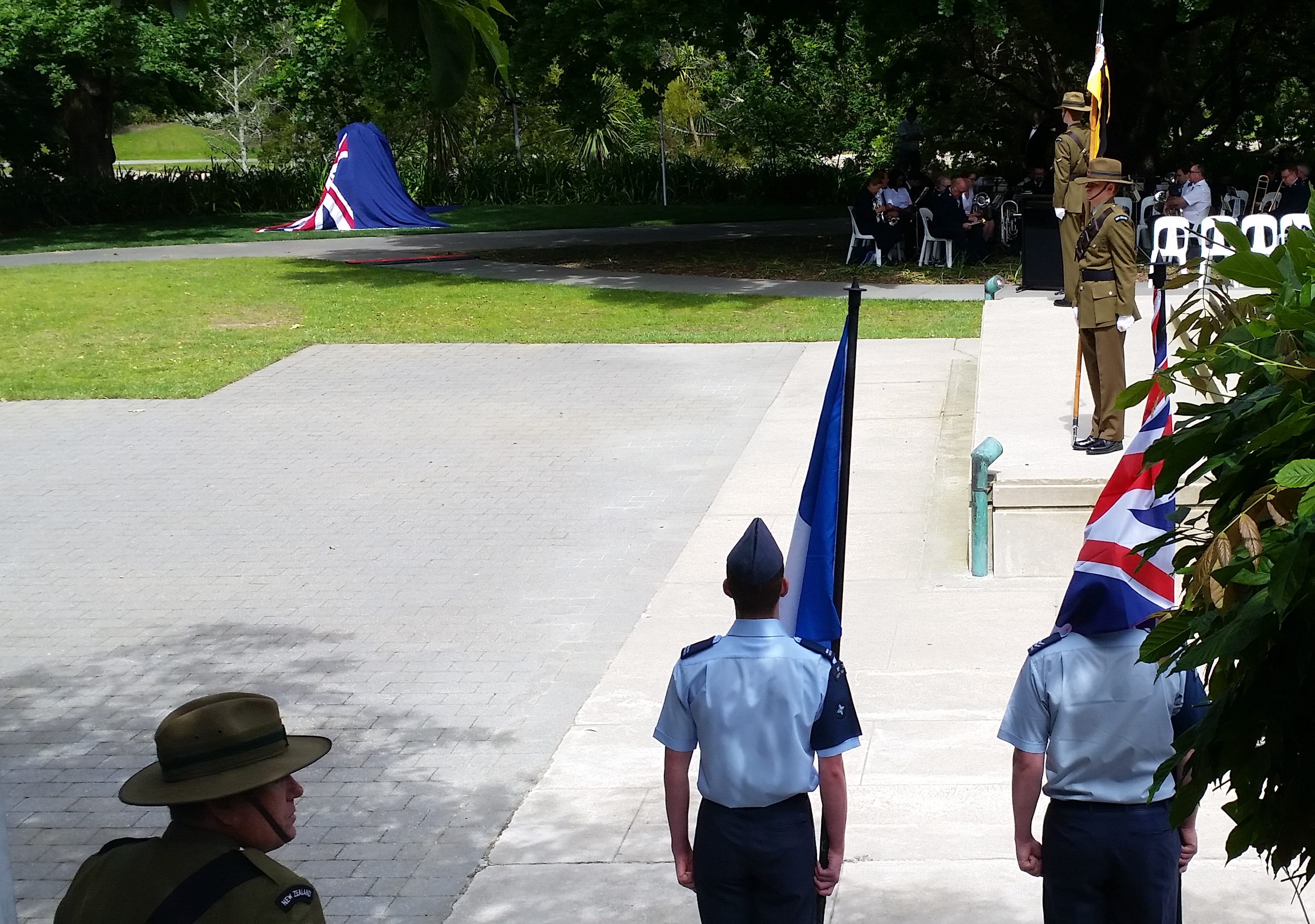
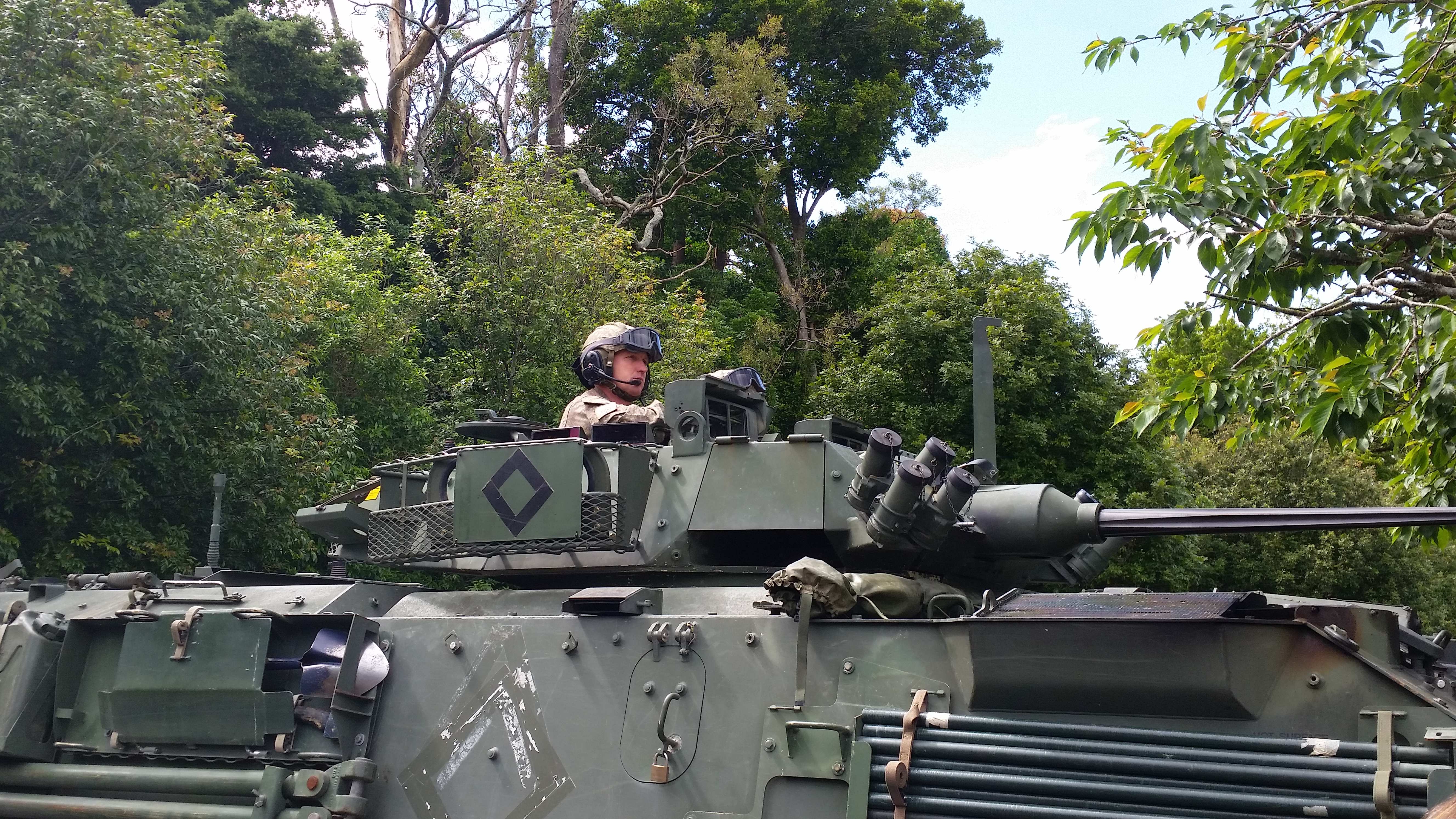
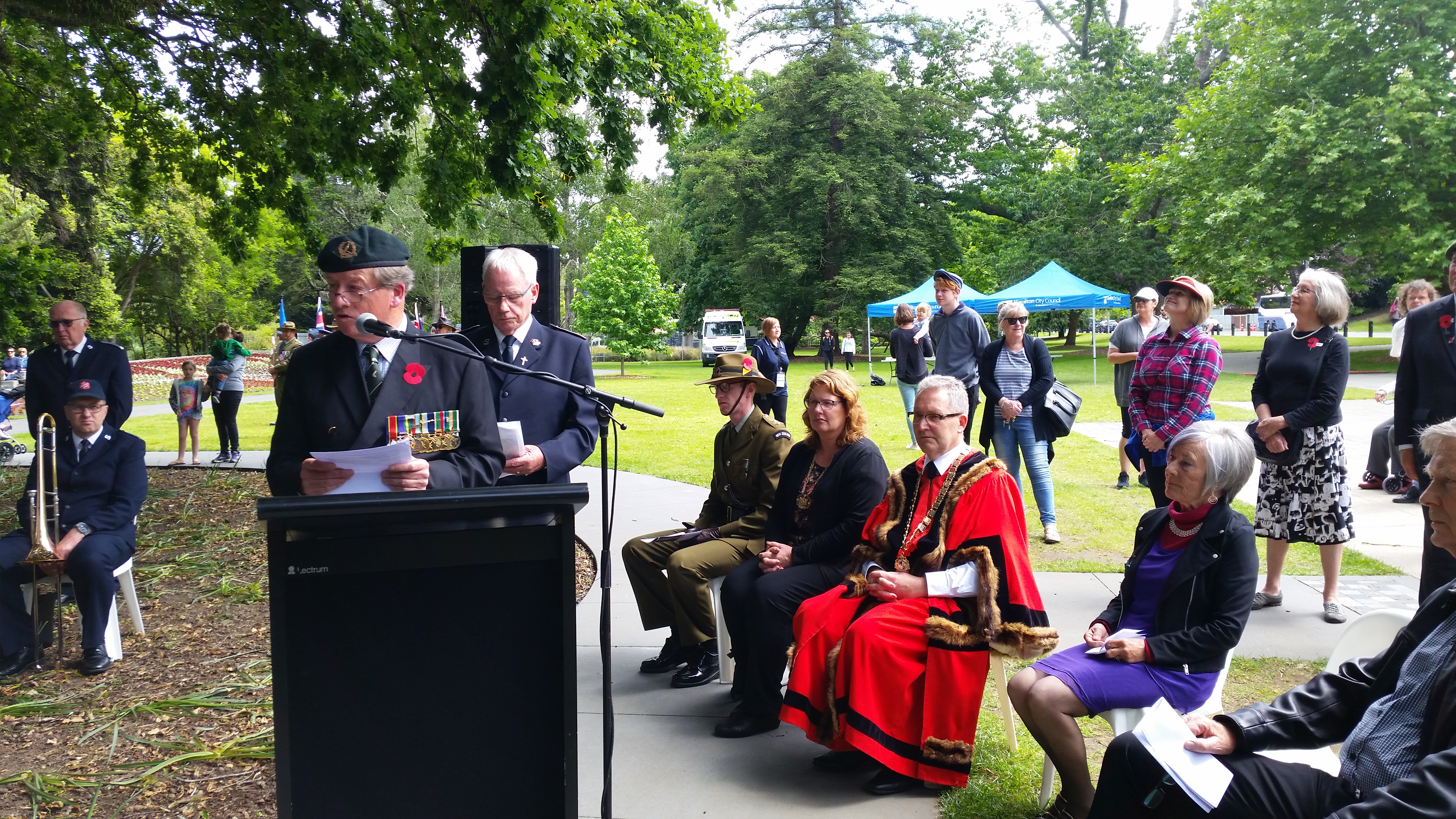
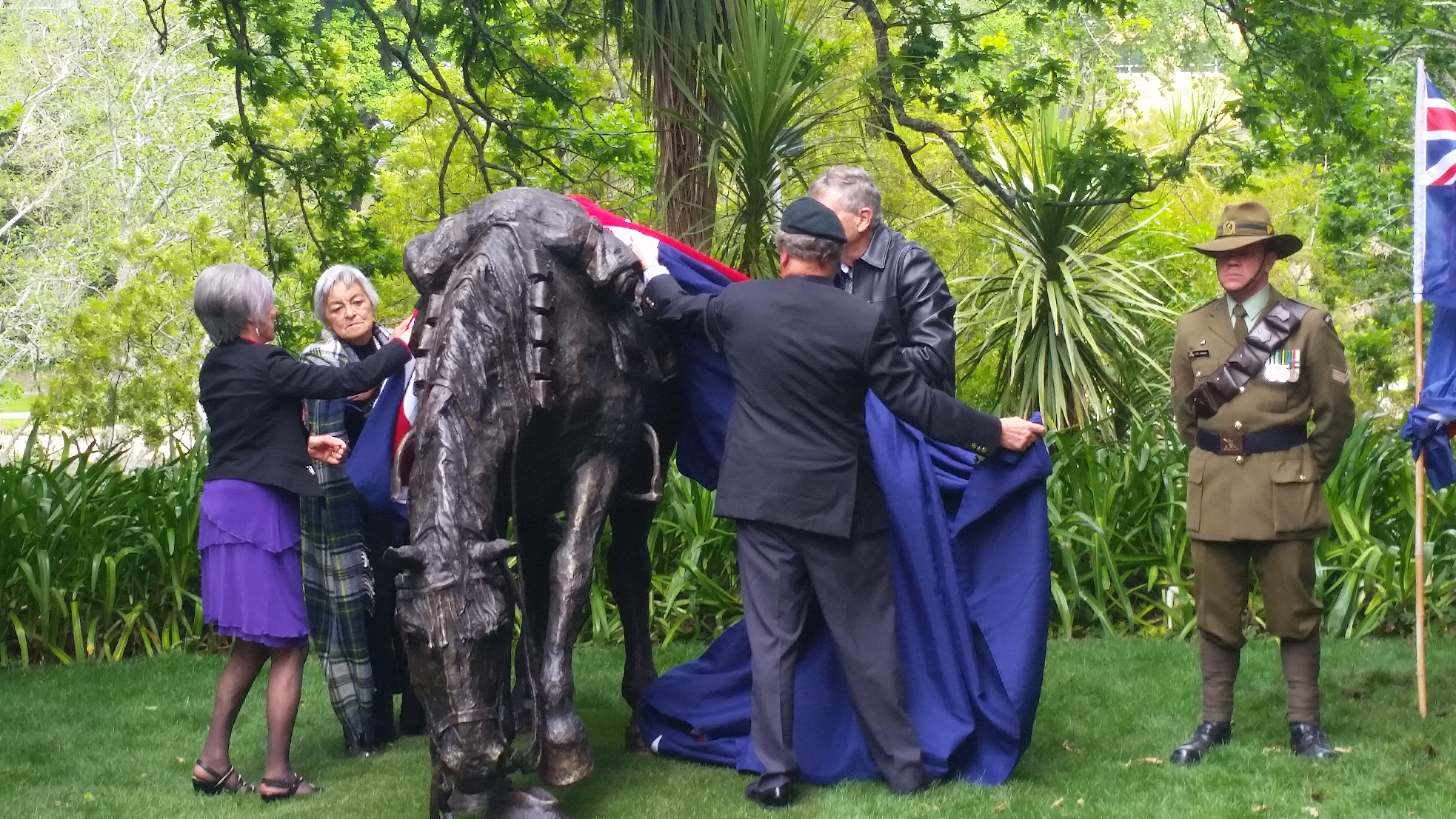
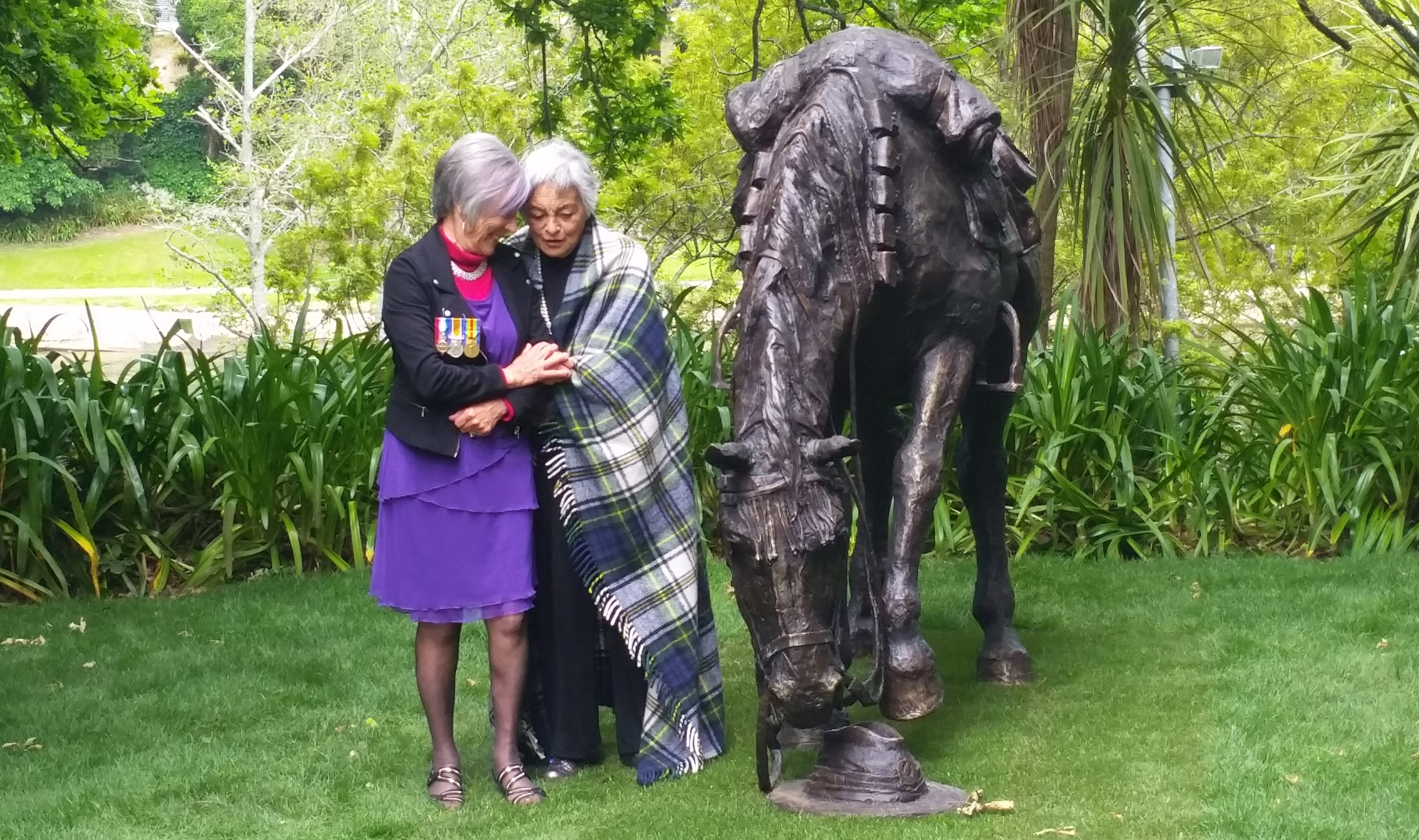
Speakers at the service acknowledged wars in which New Zealand has been engaged but the Waikato Land Wars of the 1860s were not mentioned.
The most recognised Waikato Land Wars relate to the battles of Rangiriri, Ōrākau, and Rangiaowhia in 1863-1864.
Under the direction of the Second Māori King, Tāwhiao, Māori fought British soldiers in response to the confiscation of their ancestral lands.
Hamilton City’s 2012 Tangata Whenua document states:
“The Kīngitanga (Māori King movement) was established to prevent further loss of Maori land to European settlers and posed a direct threat to colonial ambitions.”
As a result of the Kīngitanga’s defeat, 1.2 million acres of land in the Waikato was confiscated.
MacKay’s view is that the New Zealand Wars should be commemorated.
It is that this history isn’t some vacant piece of information.
It’s our history. New Zealand history.
We should know about this. We should be involved in remembering
“This was right here and we’re not even doing anything?” MacKay said.
Enlarge
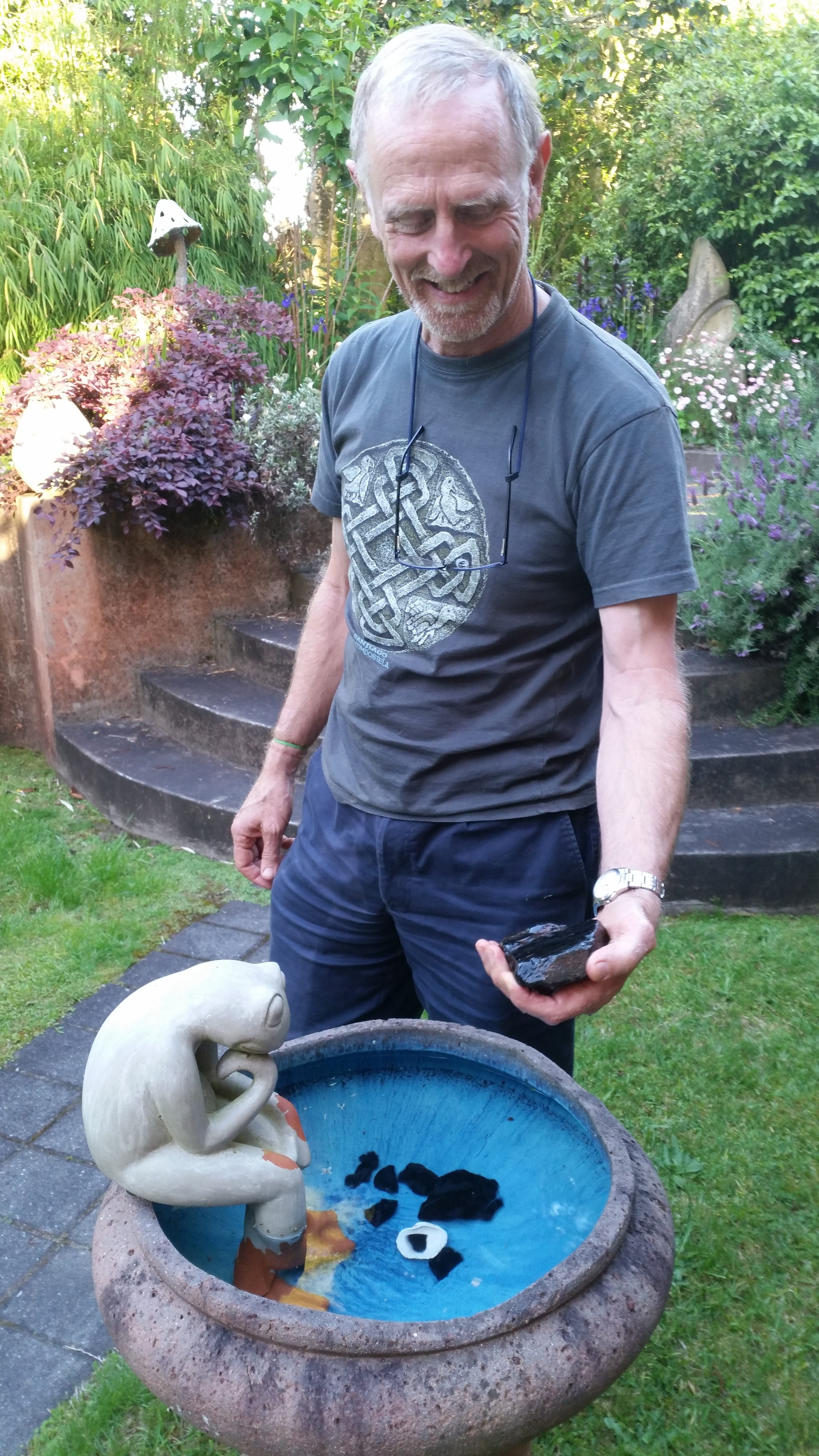
Bruce MacKay holds obsidian stone that was found on his Chartwell property. It is possible that it was used by the early Ngāti Wairere occupants as a cutting implement. Photo: Horiana Henderson
Due to his Scottish ancestry he sees similarities between the treatment of early Māori and that of his ancestors by English colonisation.
His ancestors were “kicked out of North Scotland” by way of the “Clearances,” and subjected to “horrible things”.
“They burnt their houses down around them. [Some were] 90-years of age and they’d cart them out of their houses on their beds and they were just left out in the open. They didn’t care about them.
“It’s the same thing,” MacKay said.
Coupled with finding a facebook video by Joe Trinder and reading Vincent O’Malley’s book: The Great War for New Zealand, MacKay felt compelled to act and found a few friends willing to help.
His approach was to source names of those Māori “resistance warriors” that went to war for land and sovereignty in the Waikato.
Wiremu Tamihana (about 1805-1866) was a Kīngite and was acknowledged by the New Zealand Herald in 2013 as New Zealander of the year for 1863. He displaced Governor George Grey from the position.
It was a quote attributed to Tamihana that provided the title for O’Malley’s book.
The Ngāti Hauā chief said:
No te taenga ki te kohuru i Rangiaohia, katahi au ka mohio he tino pakanga nui tenei, no Niu Tireni.When it came to the (time of the) murder at Rangiaohia, then I knew, for the first time, that this was a great war for New Zealand
MacKay worked for the Hamilton City Council from 1986-2001, during which he was responsible for planting trees in Steele Park (Te Nihinihi) to replace any that had died.
It was then that he learned about the 4th Waikato Militia.
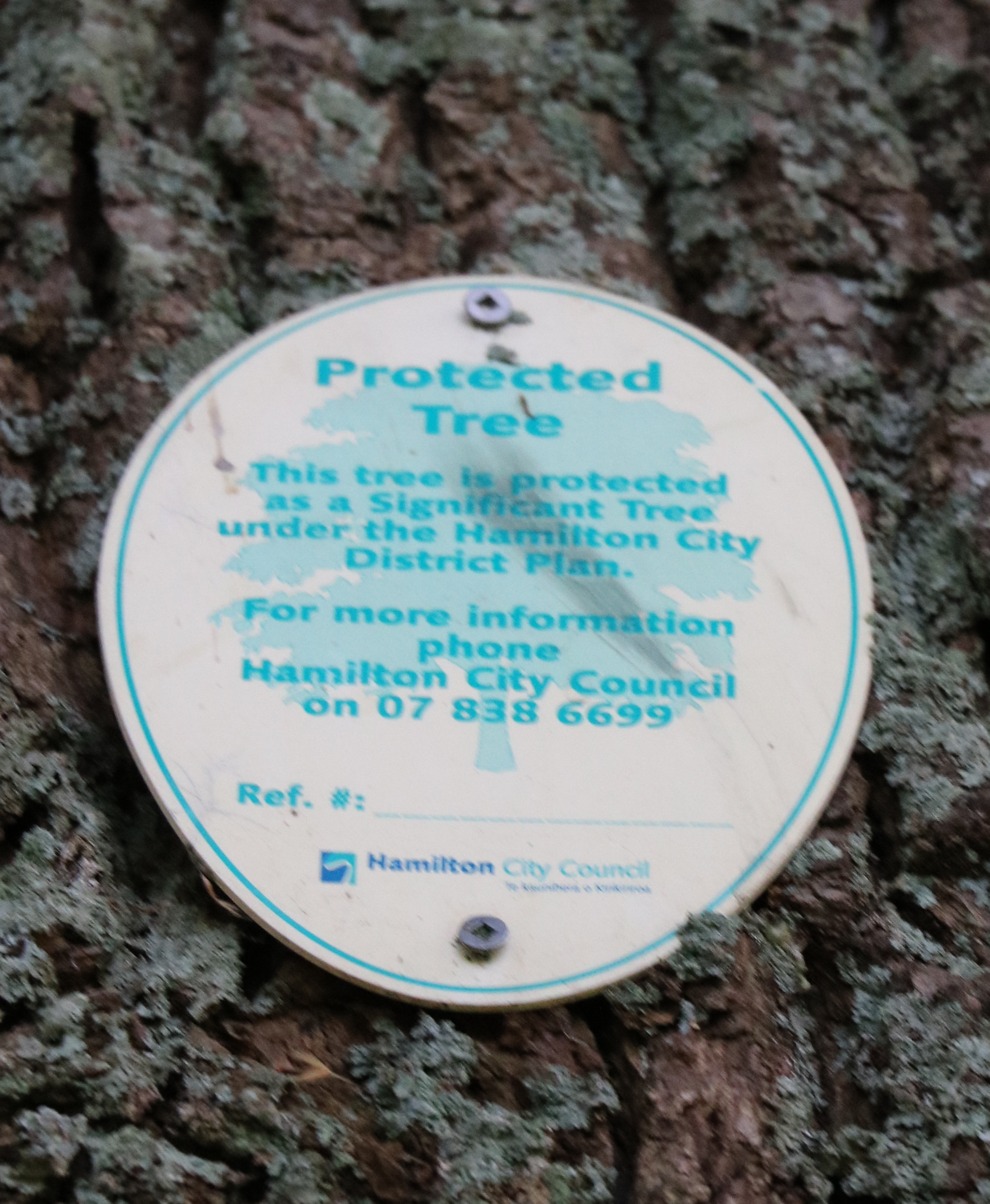
The militia held a 25th Landing Anniversary in 1889 and planted 50 oak trees around the perimeter of the park which was then named Sydney Square. The trees were named after them and are protected.
Rā Maumahara MacKay commissioned red sashes to be tied around the trees. They had the names of Māori warriors in order to ensure both sides of the Waikato Land Wars were remembered and represented.
Enlarge
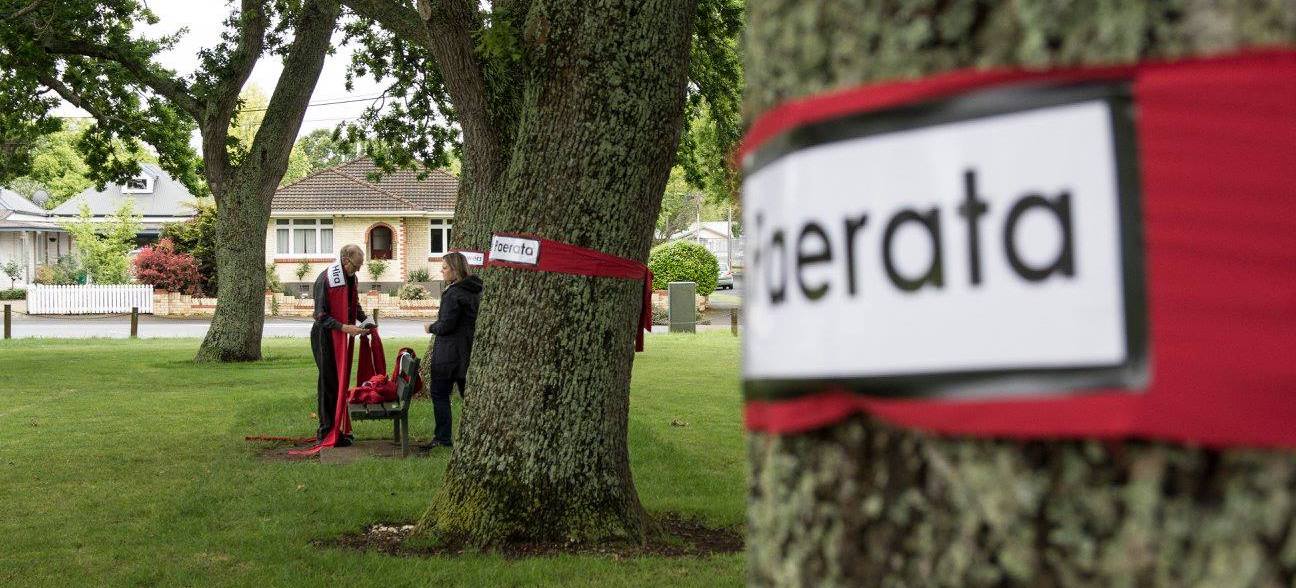
Bruce MacKay with five helpers tied Māori remembrance ribbons around 50 Steele Park oak trees. Photo: Supplied.
A member of the public commented on MacKay’s activities.
“One guy came up and said: ‘I think you’re being disrespectful putting those around the trees. They were planted for militia.’”
MacKay’s response was: “Militia had no right to be here.”
“I just read a little bit about Kihikihi. It amazes me. They just marched into these places and took them over,” he said.
“I wasn’t too happy with this guy saying we were being disrespectful because, actually, I’ve done a lot of work to protect the trees and protect the history,” the ribbon-tier said.
At the ceremony MacKay distributed hand-outs with known details about participants of the Waikato Wars.
Grey, Cameron, Heaphy, Von Tempsky, Knox, and Nixon, are some of the streets in Hamilton named after British Governors and officers who played significant roles at Rangiriri, Ōrākau, and Rangiaowhia, according to MacKay’s research.
Enlarge
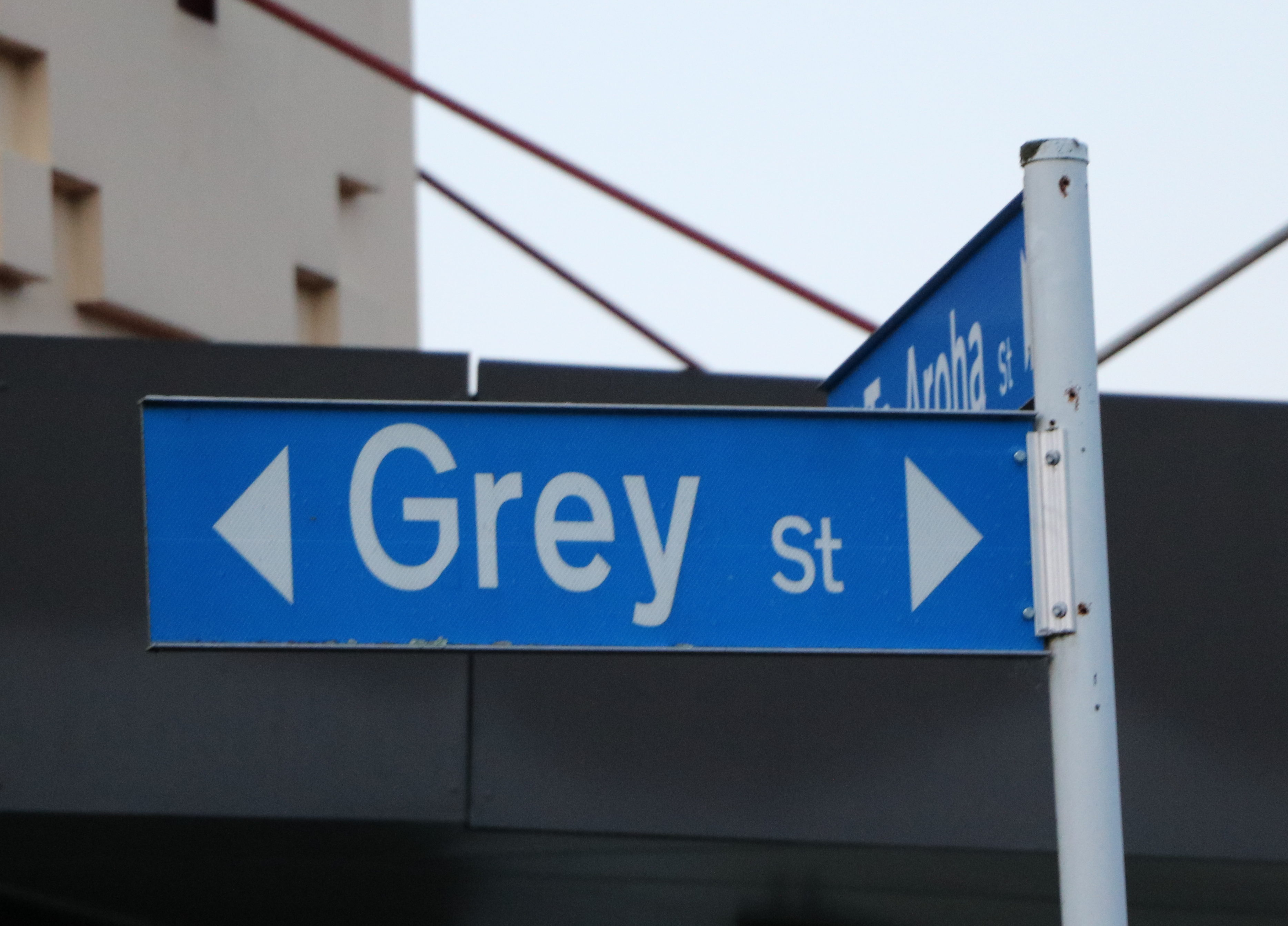
Hamiltons Grey Street is named after Governor George Grey (1812-1898). Photo: Horiana Henderson
“And Whitaker Street out in Cambridge [and Kihikihi and Te Aroha]; I put those in there as well because [Fredrick] Whitaker (1812-1891) was actually a big player and he made a lot of money. He speculated on the confiscated lands and he was also in Parliament,” MacKay said.
He also acknowledged Frankton’s history.
“Frank Jolly [1865-1943], he’s the guy Frankton’s named after. He owned a big lot of land over there,” MacKay said.
The Hamilton Dinsdale Library currently have an entrance-way display for the Frankton-sire, whose father, Thomas Jolly brought the 400 acres of confiscated Kirikiriroa land from 4th Waikato Militia-man Major Jackson Keddell (1831-1862).
Enlarge
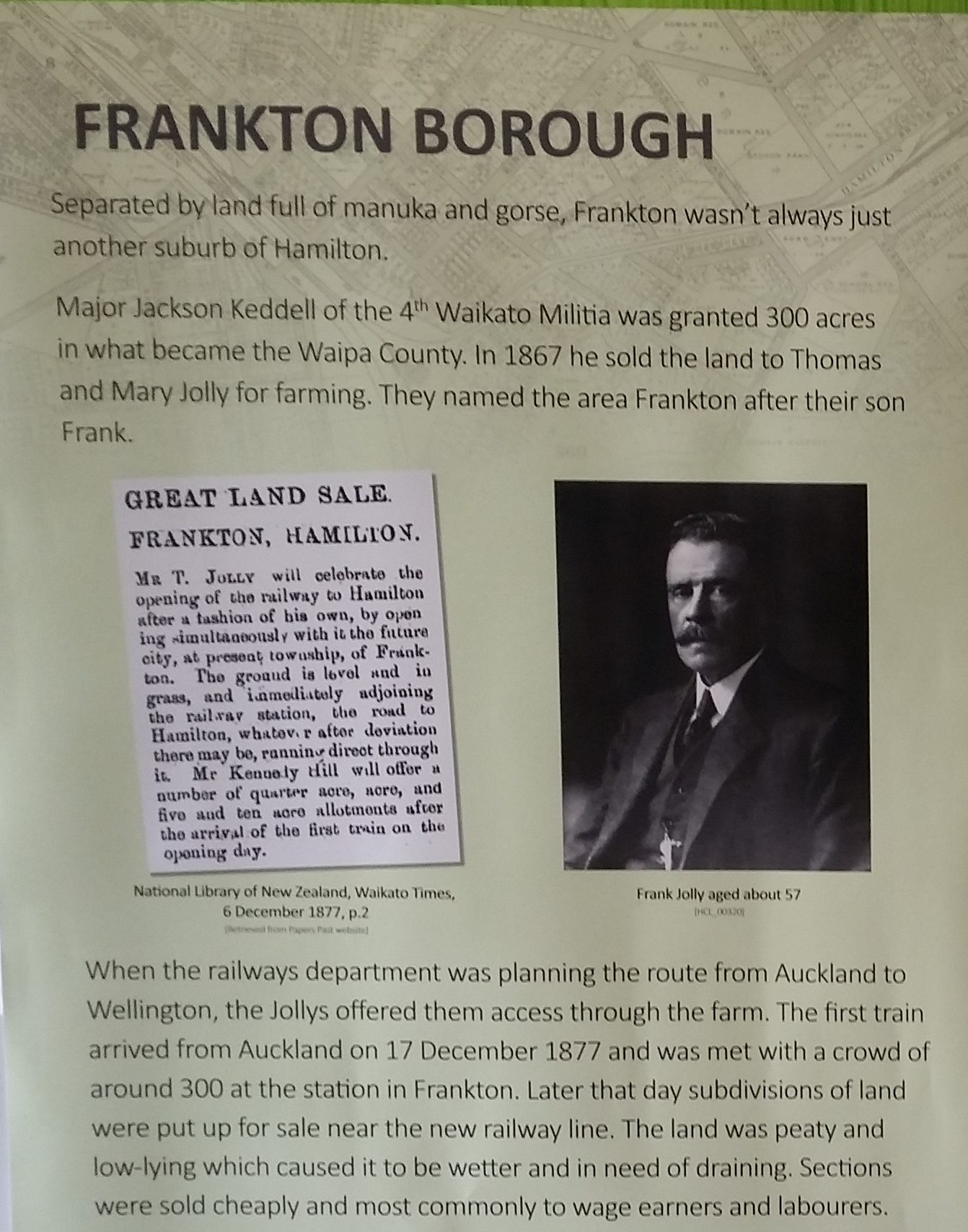
Hamilton Dinsdale Library display commemorating Frank Jolly after whom Frankton is named. Photo: Horiana Henderson
Jolly named a street in his suburb after Keddell in 1904.
Joe Trinder’s video stars his daughter who asks why street names of Māori warriors from the Waikato Wars don’t exist.
“I don’t see how we are all one people when there are streets named after Bryce, Von Tempsky, and not Titokowaru,” she said.
MacKay was moved when looking over the Māori names identified in connection with the Waikato Wars such as Kereopa Te Rau, whose wife and two daughters died at Rangiaowhia.
Enlarge

MacKay distributed hand-outs on Rā Maumahara. Whitiora Te Kumete is documented for commenting on the events at Rangiaowhia in 1864. Photo: Horiana Henderson
His determination to hold the event was set but he kept it quiet to avoid interference.
He met with the Waikato Times two days prior otherwise announcement was made by word-of-mouth.
“I didn’t want them trying to close it down,” MacKay said.
He said that he was contacted by a council officer after the newspaper article’s release for not lodging his plans with them.
He stated that he did have a booking and that it was not a council but a community-led initiative.
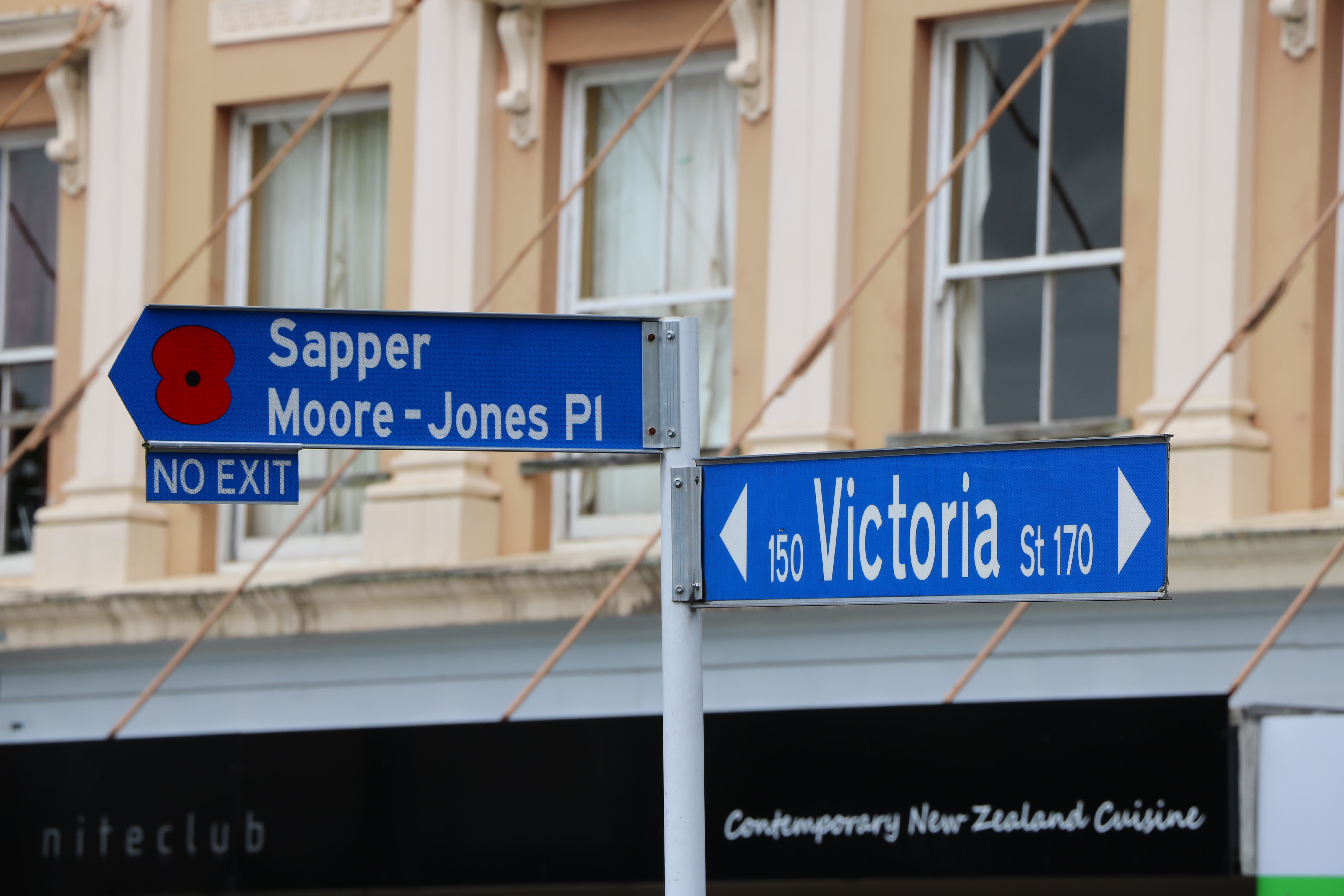
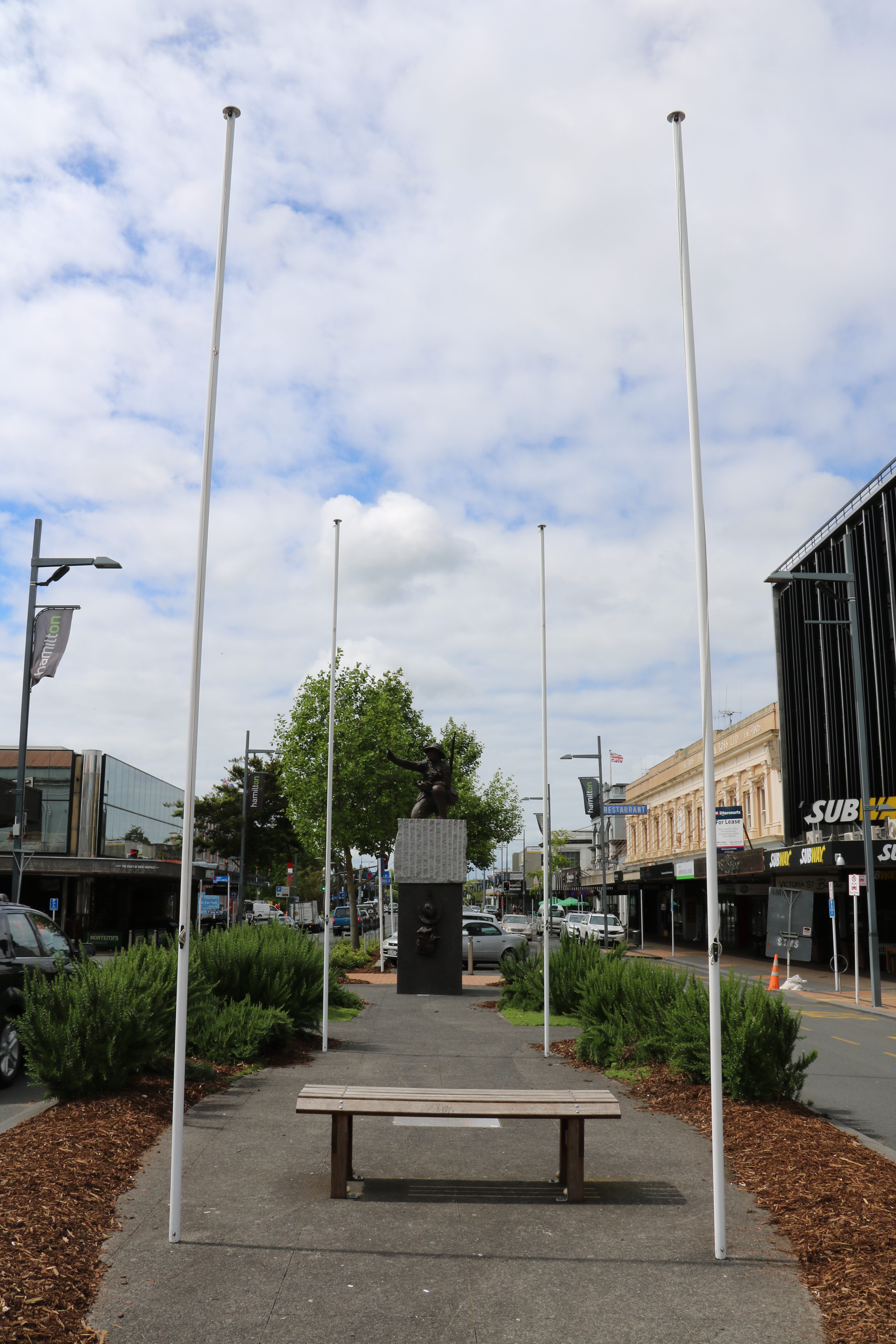
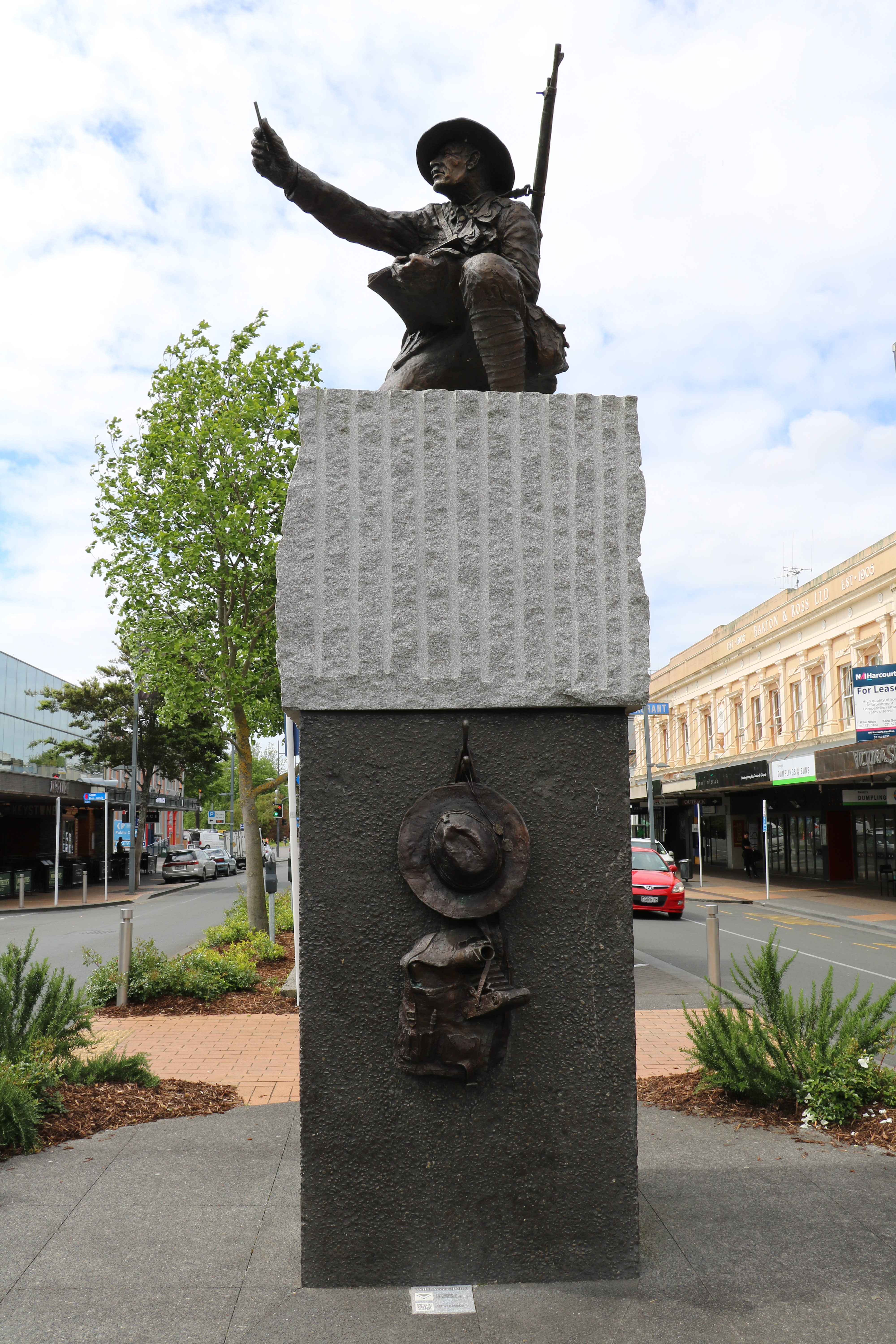
Six-months earlier he had submitted a letter to the newspaper asking council to consider street name changes to reflect the town’s Māori heritage.
He cited the change of Bridge Street to Anzac Parade as a reference.
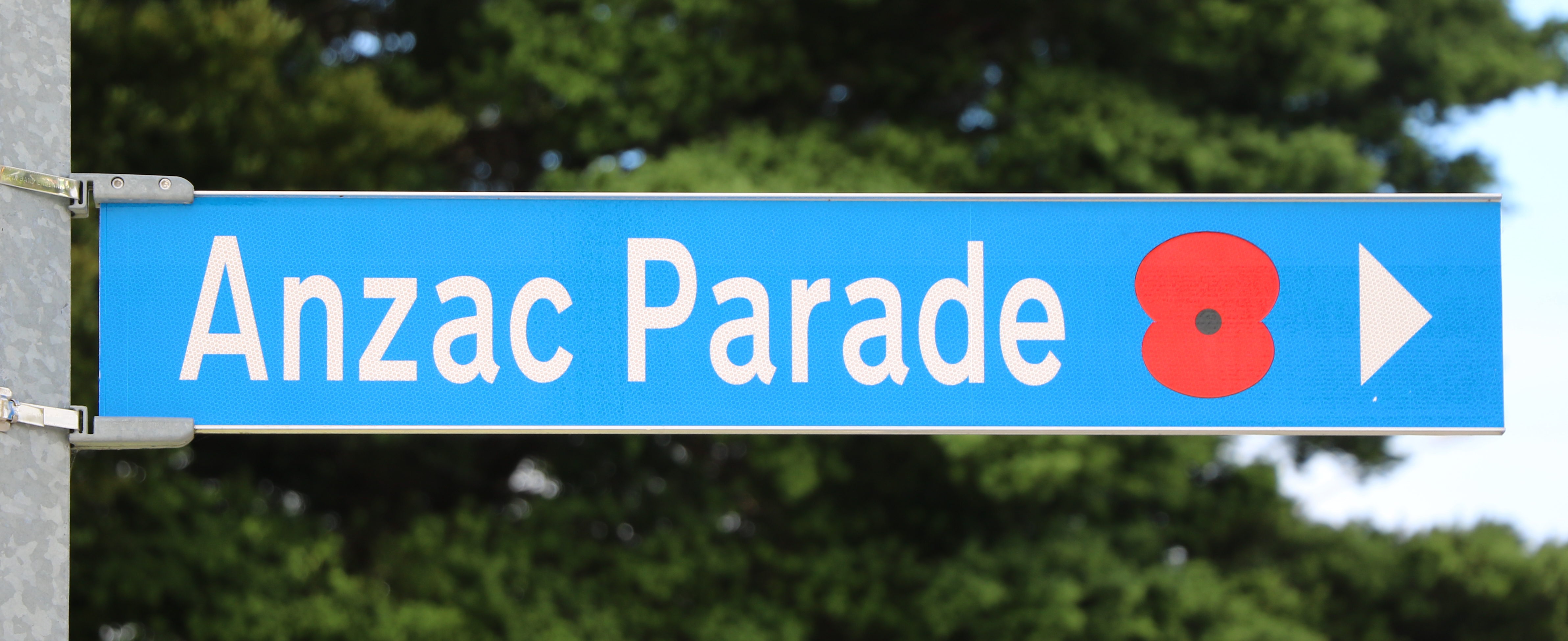
“So, that’s where it started,” MacKay said.
From inception, in July, to a team of six, working for two-hours to tie sashes around trees–45 named and some blank to honour the unknown–the heritage militia park was ringed in red on Rā Maumahara.
When invited to speak at the ceremony MacKay remembered saying:
“I just think that putting ribbons around the trees actually combines the history of Pākēha and Māori.”
“It actually says: this is what Pākēha did and now we’re putting Māori names on there and trying to remember them as well.”
It actually says: This is what Pākēha did
“That’s really important and it combines our histories in a different way.”
It was a “really wet” day and the turn out numbered about 30 people.
City Councillor Martin Gallagher, Ngāti Maniapoto kaumātua Tom Roa, Ngāti Wairere kuia Hekeiterangi Broadhurst and Ngāti Wairere historian Wiremu Puke were in attendance.
“I was worried it wasn’t going to happen,” MacKay said.
He was satisfied at the end of the 1-hour ceremony and left the ribbons in place until the next afternoon.
The ribbons will be gifted to Ngāti Wairere.
Puke helped MacKay identify some names for the ribbons, such as the last Ngāti Wairere chief to live at Kirikiriroa Pā, Hoera Taonui.
Hoera Taonui led his people to the Battle of Rangiriri and is presumed to have died there in 1863.
Enlarge
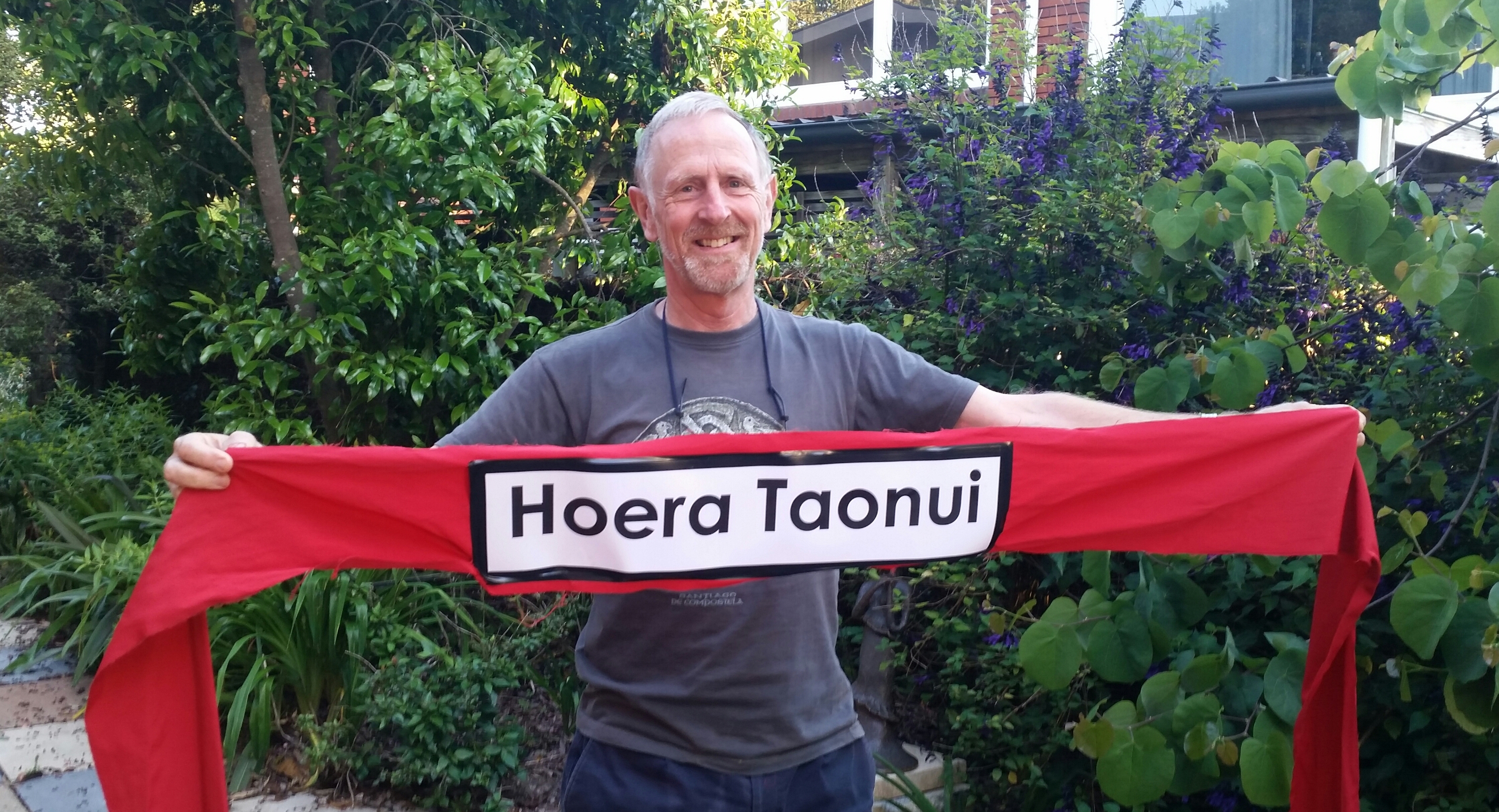
MacKay holds a Rā Maumahara ribbon for Hoera Taonui. Hoera Taonui was Kirikiriroa Pā's last Chief and led Ngāti Wairere to the Battle of Rangiriri in November 1863. He is presumed to have died there. Photo: Horiana Henderson
More names came from O’Malley’s book and other Waikato hapū.
As MacKay was tying the ribbons, Puke alerted him to the fact that one of the names belonged to a relative.
“It becomes real when it touches yourself and when it touches people that you know and you realise, actually, their ancestors were caught up in this.”
“That’s what makes it important,” MacKay said.
His vision is to see Hamilton renaming streets and parks in honour of its Māori heritage.
“Until the council gets the message and starts to name a park after one of the wars; they have a Memorial Park and a New Memorial Park, they should have a Memorial park for all the Land Wars really.”
Enlarge
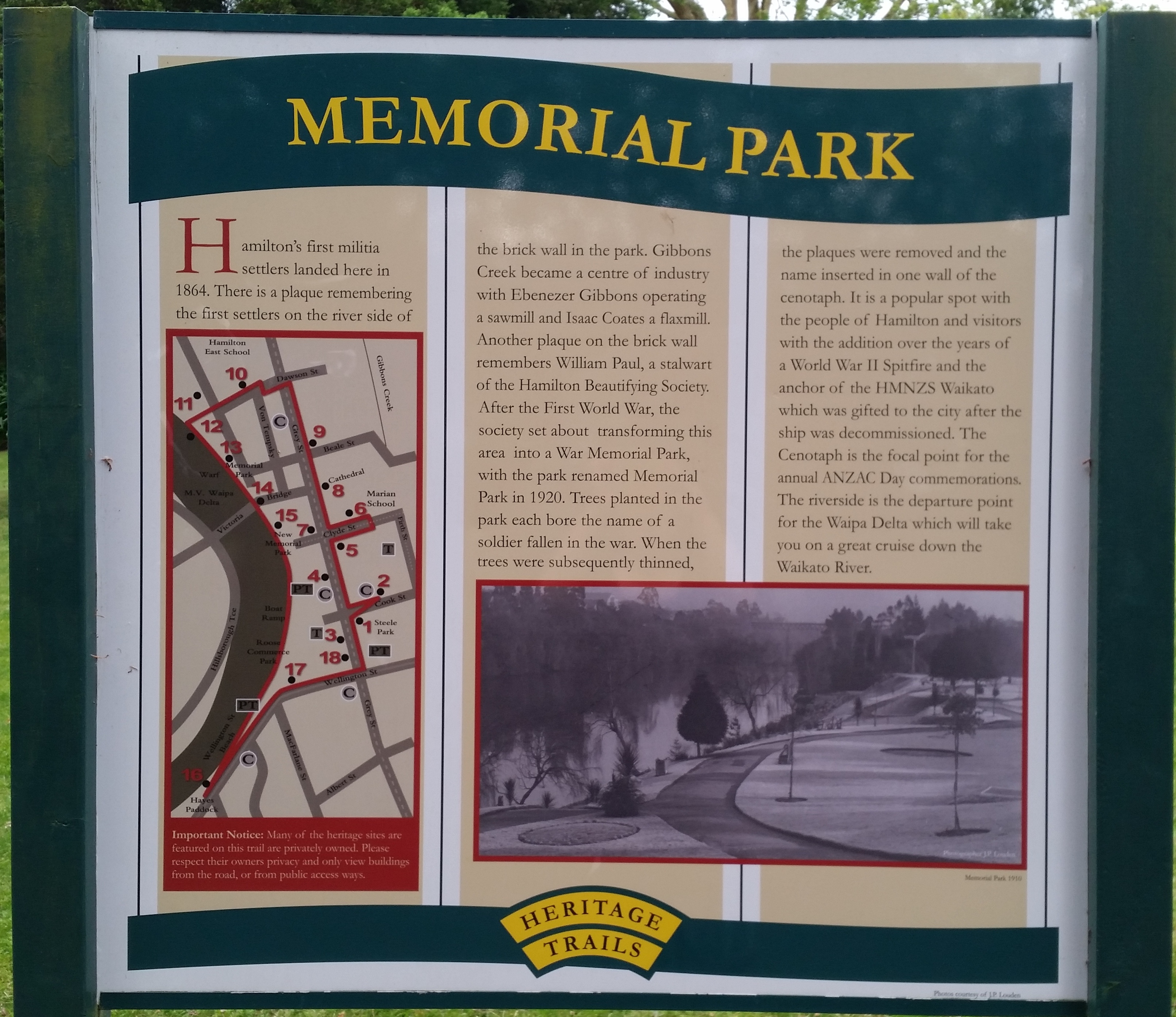
Hamilton's Memorial Park is located on River Road. Photo: Horiana Henderson
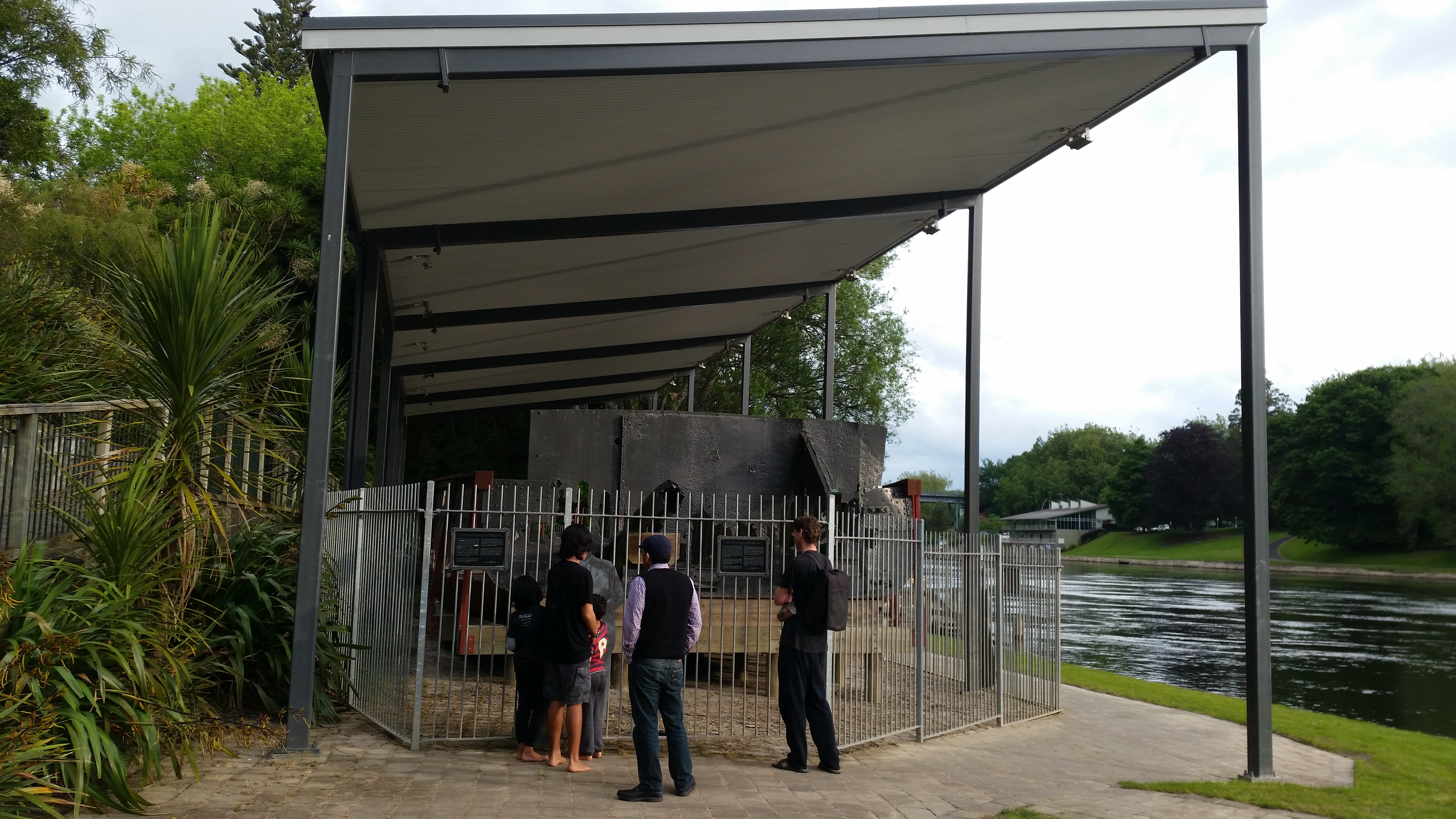
The Hamilton City Council’s River Road Memorial Park webpage states that it: “contains memorials to various wars and events significant to Hamilton.”
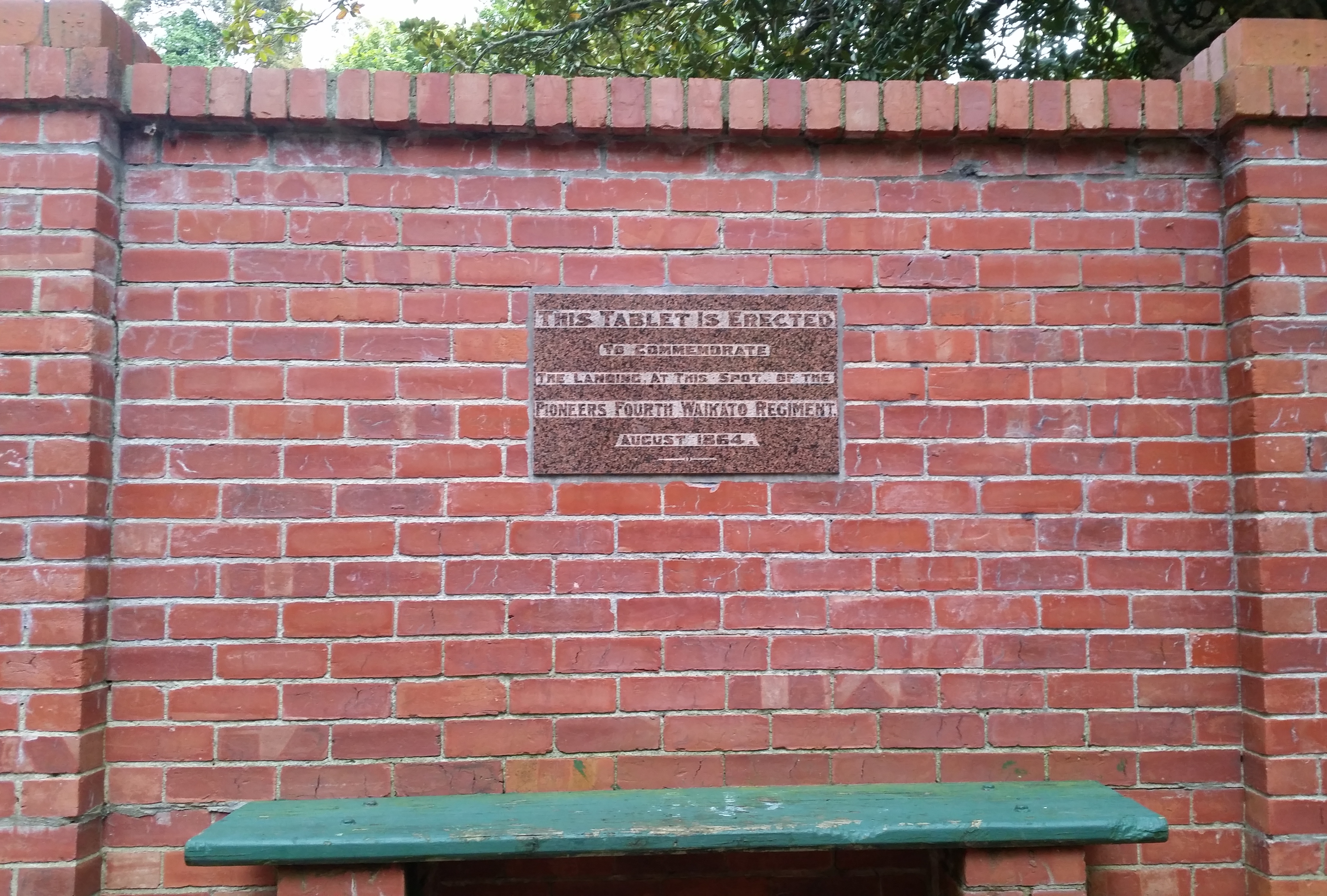
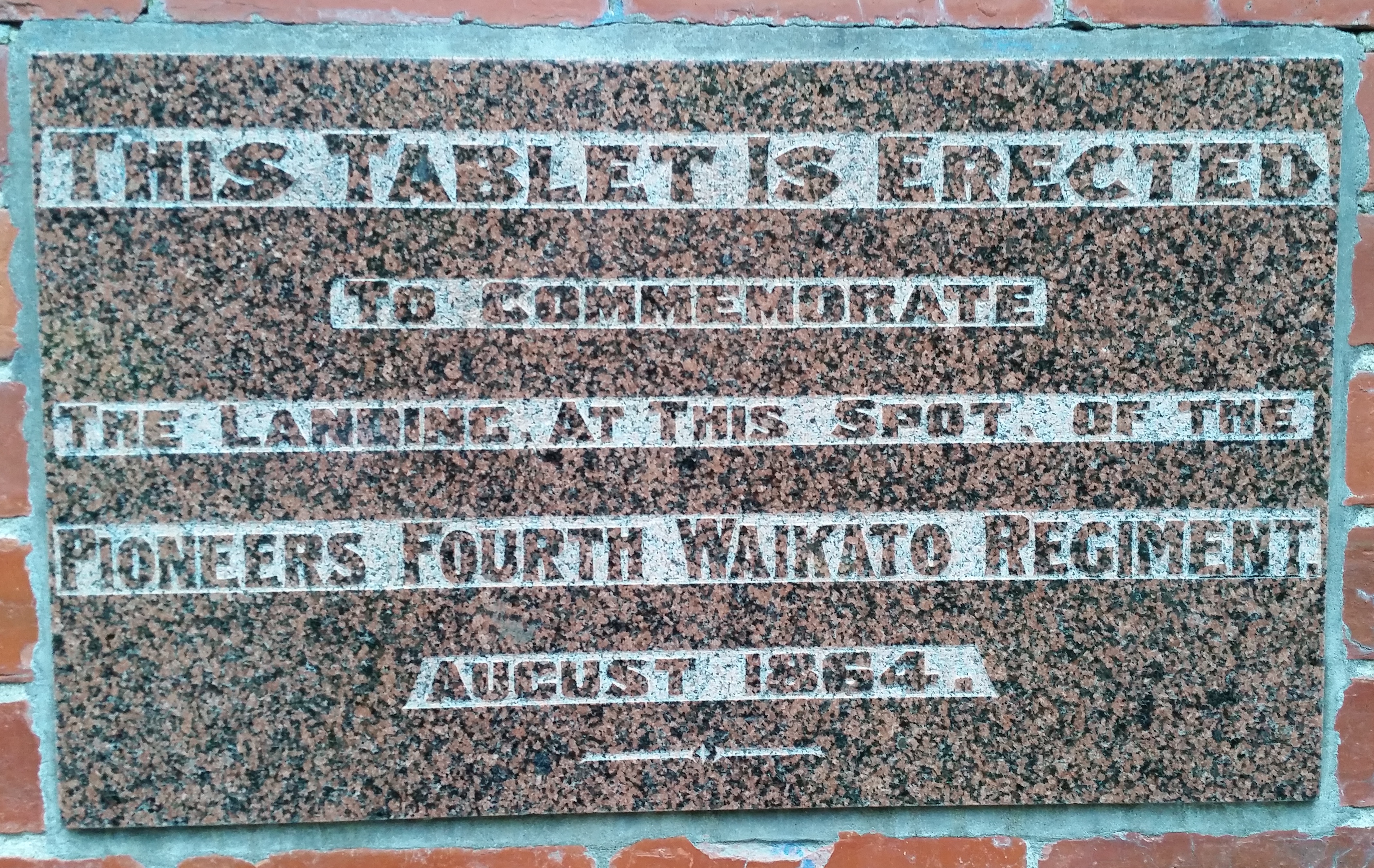
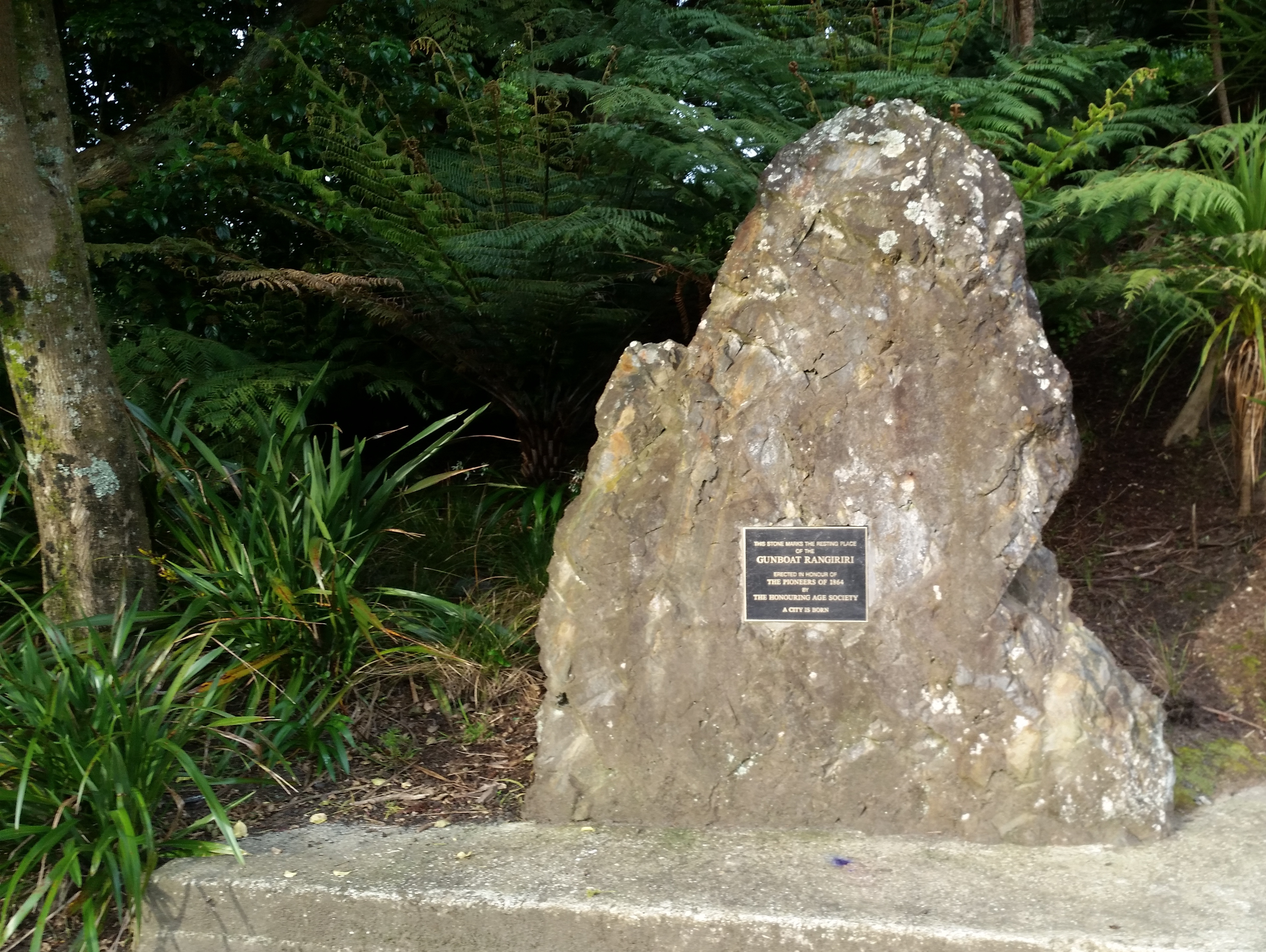
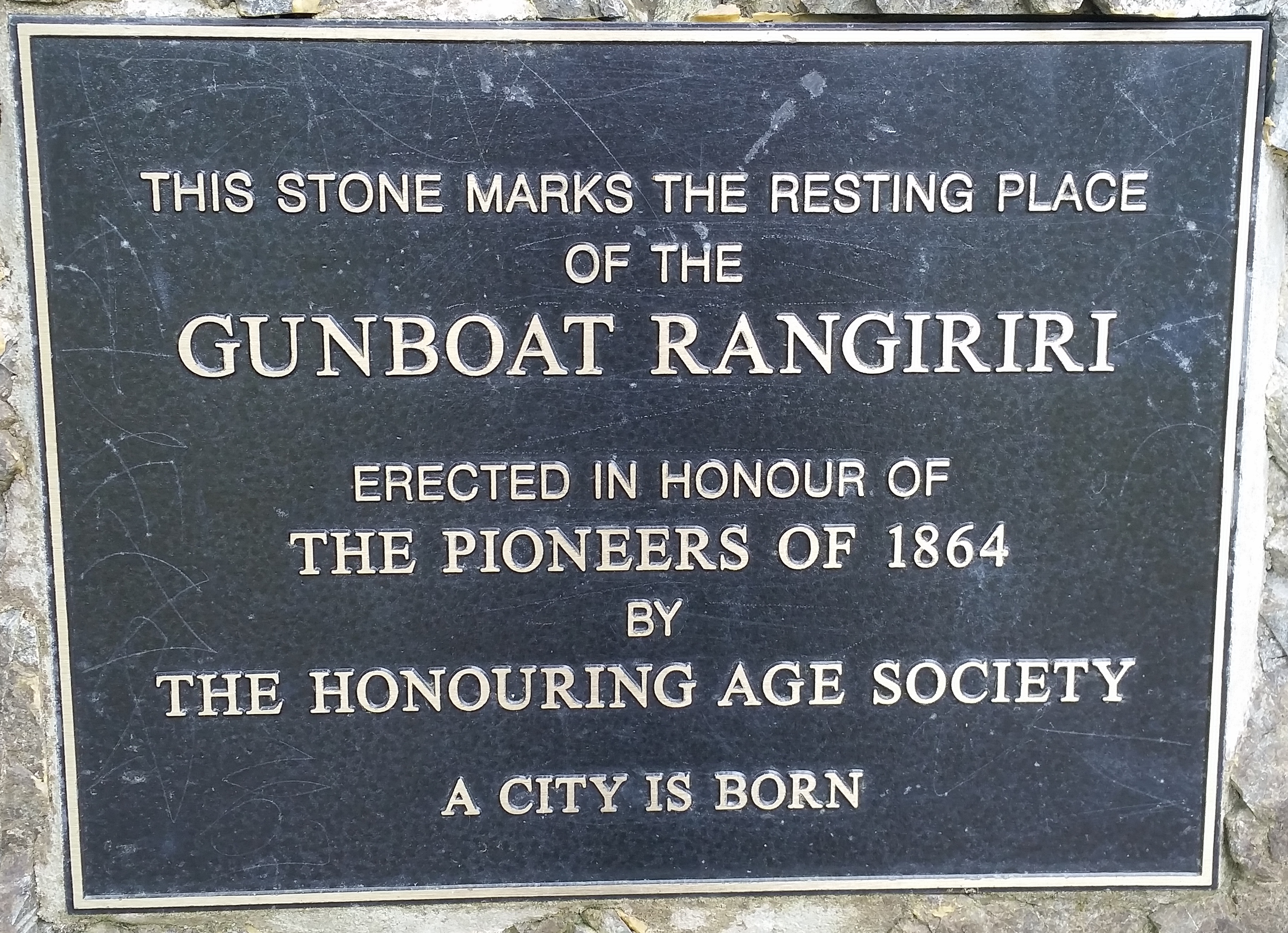
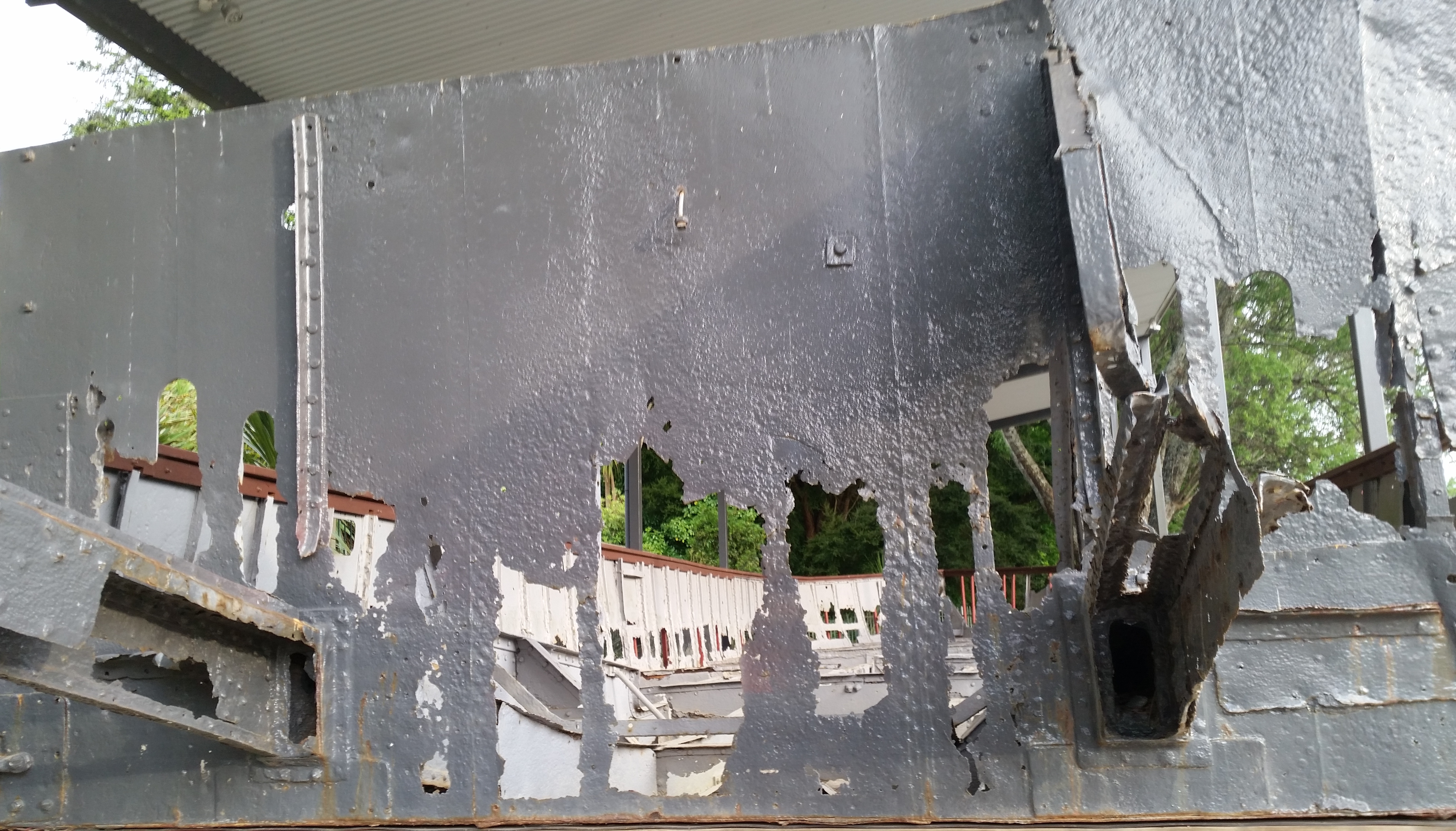
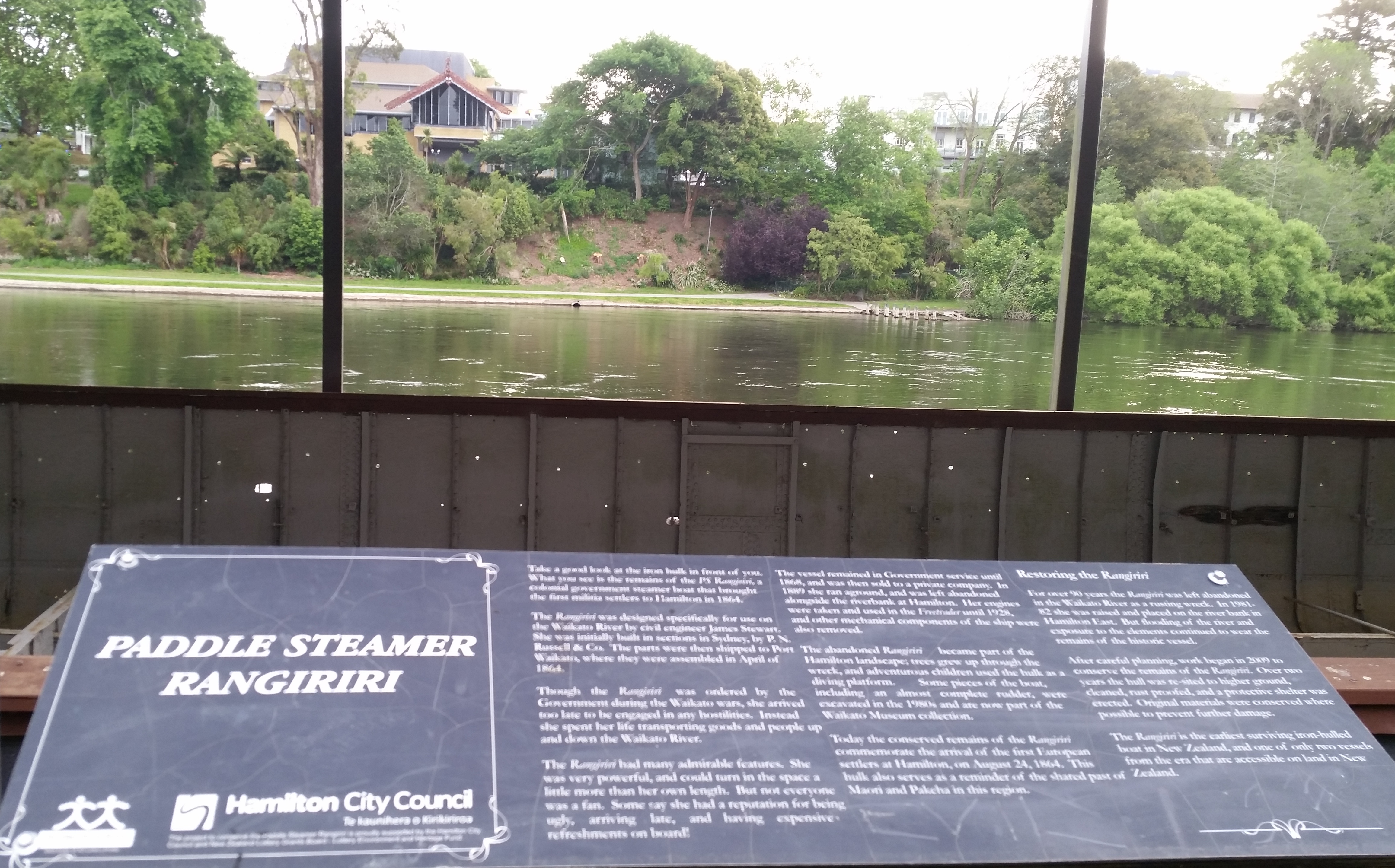
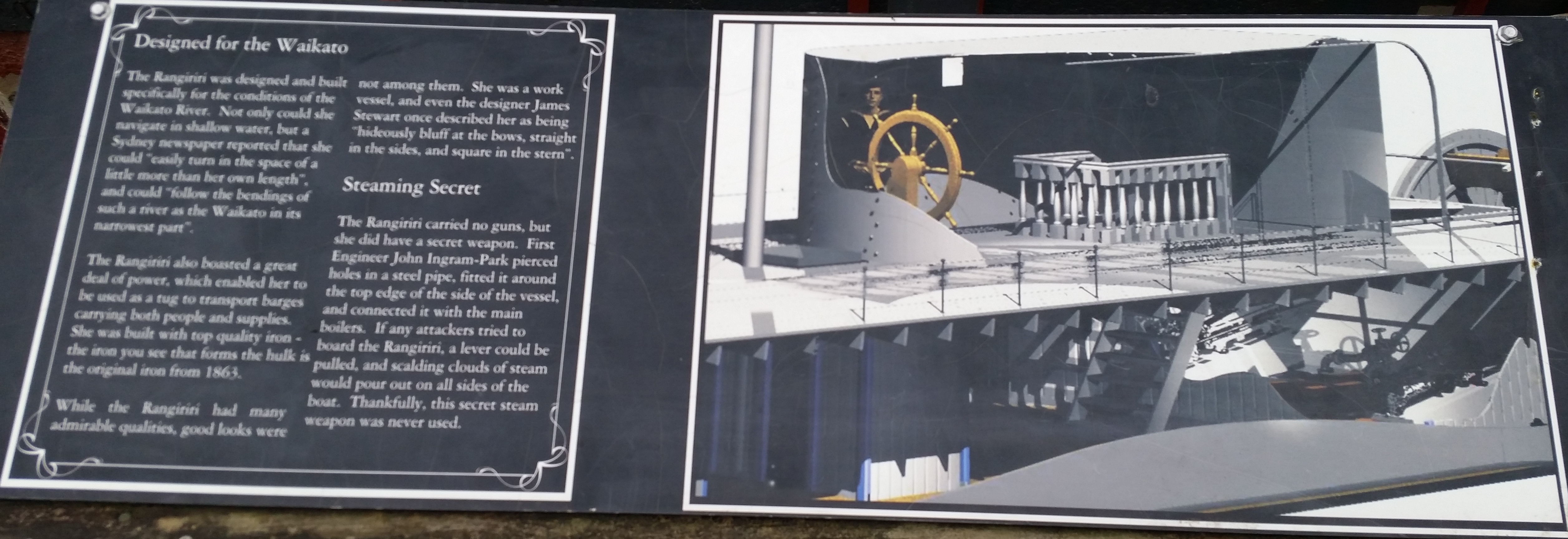
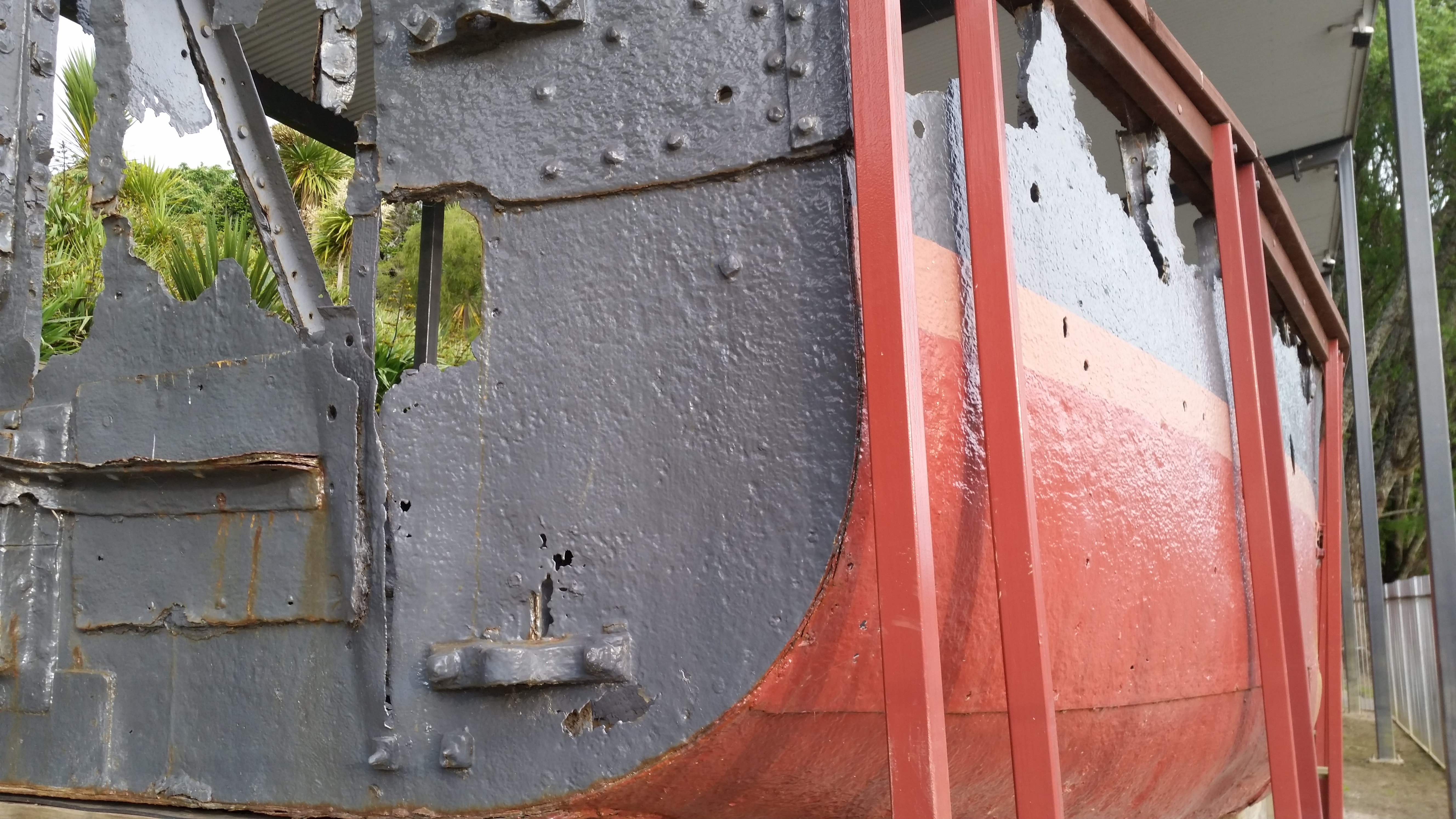
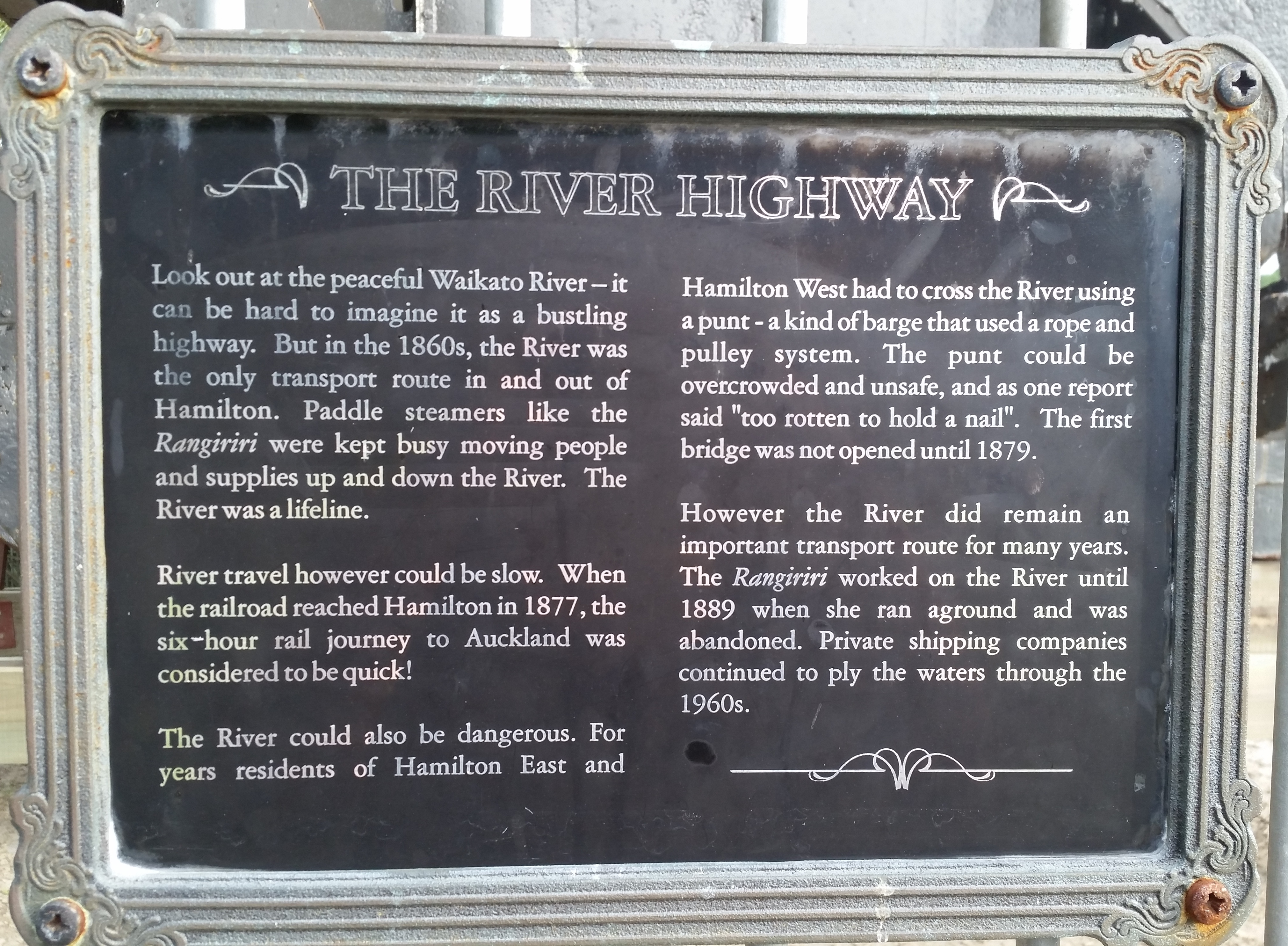
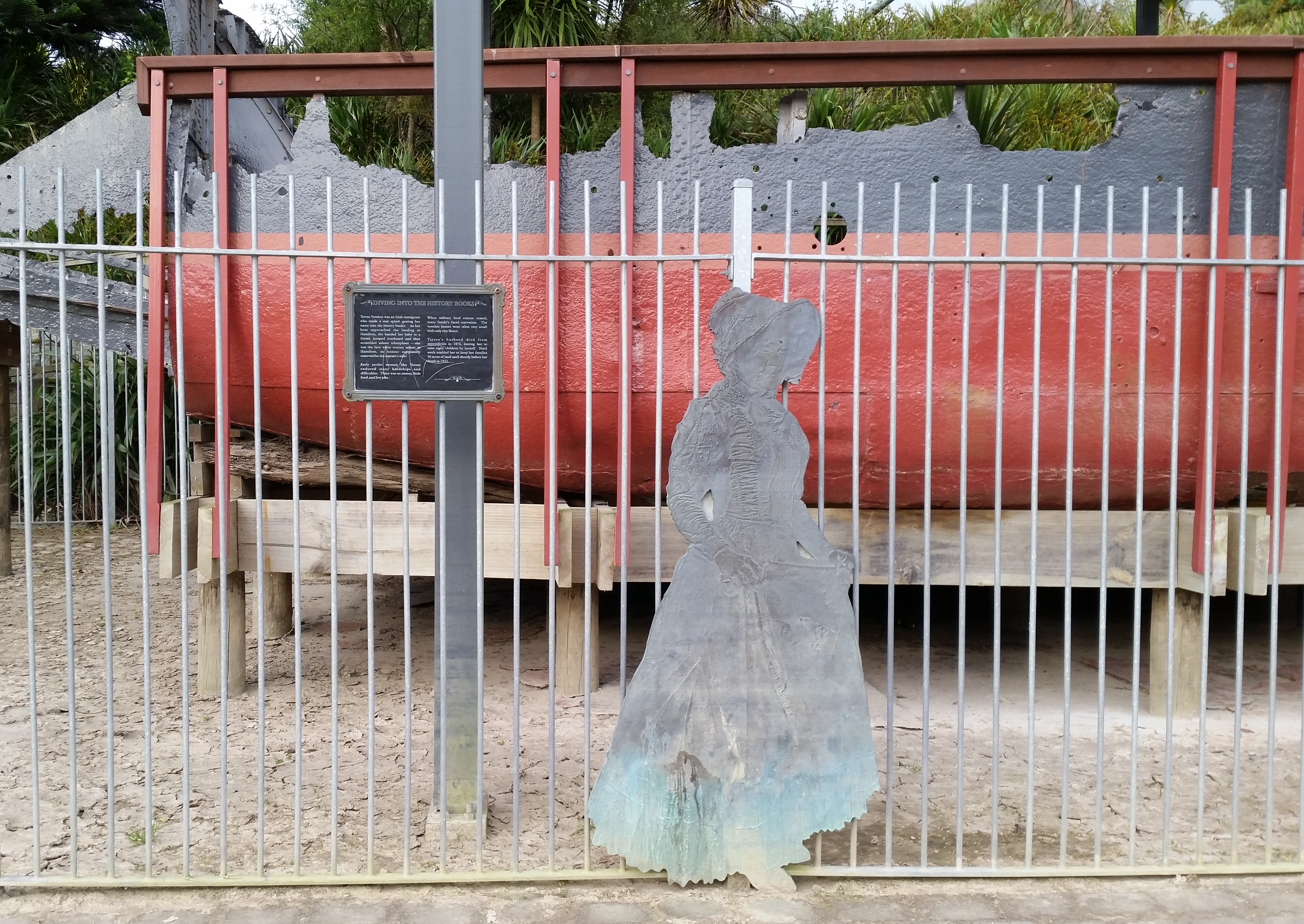
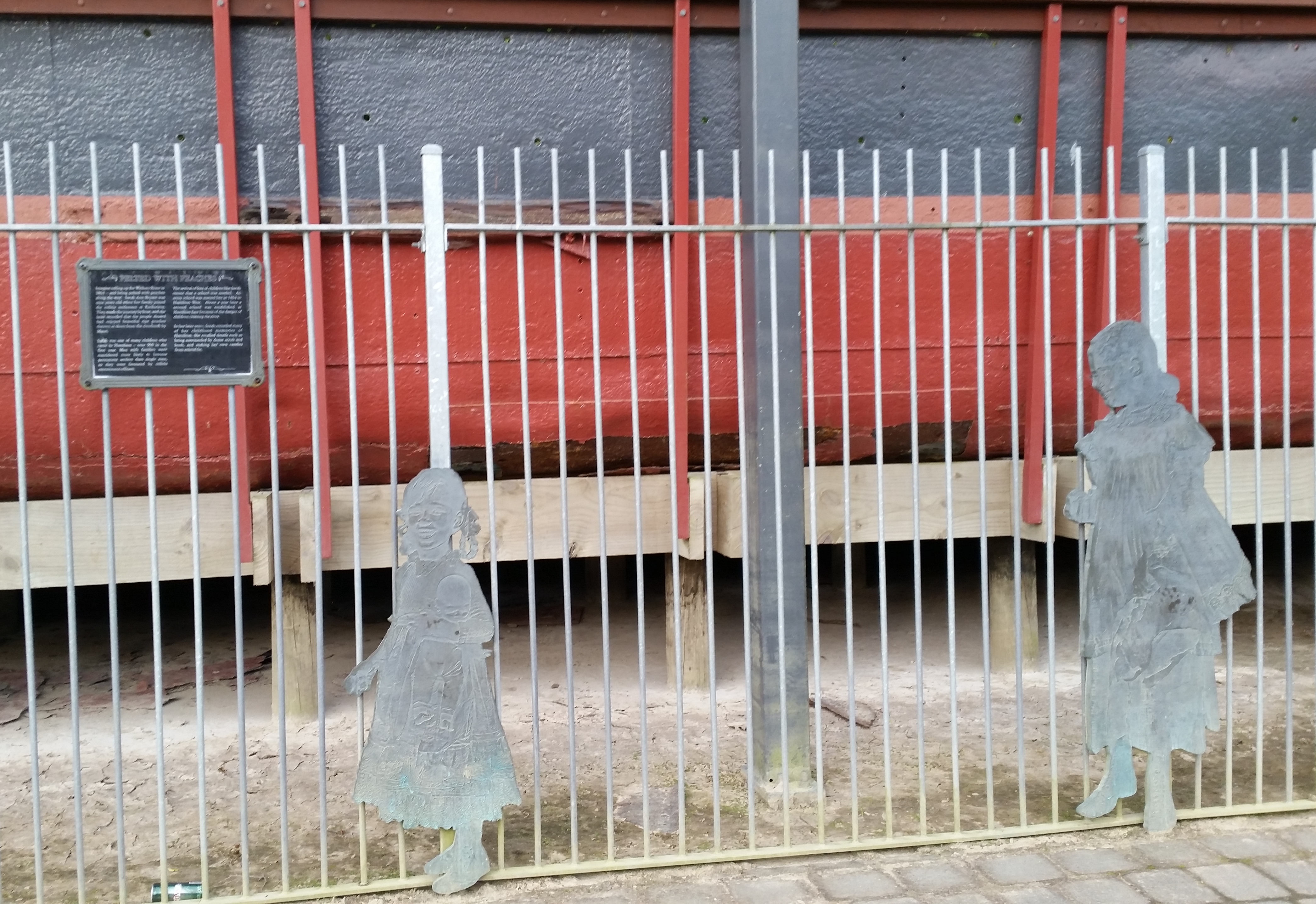
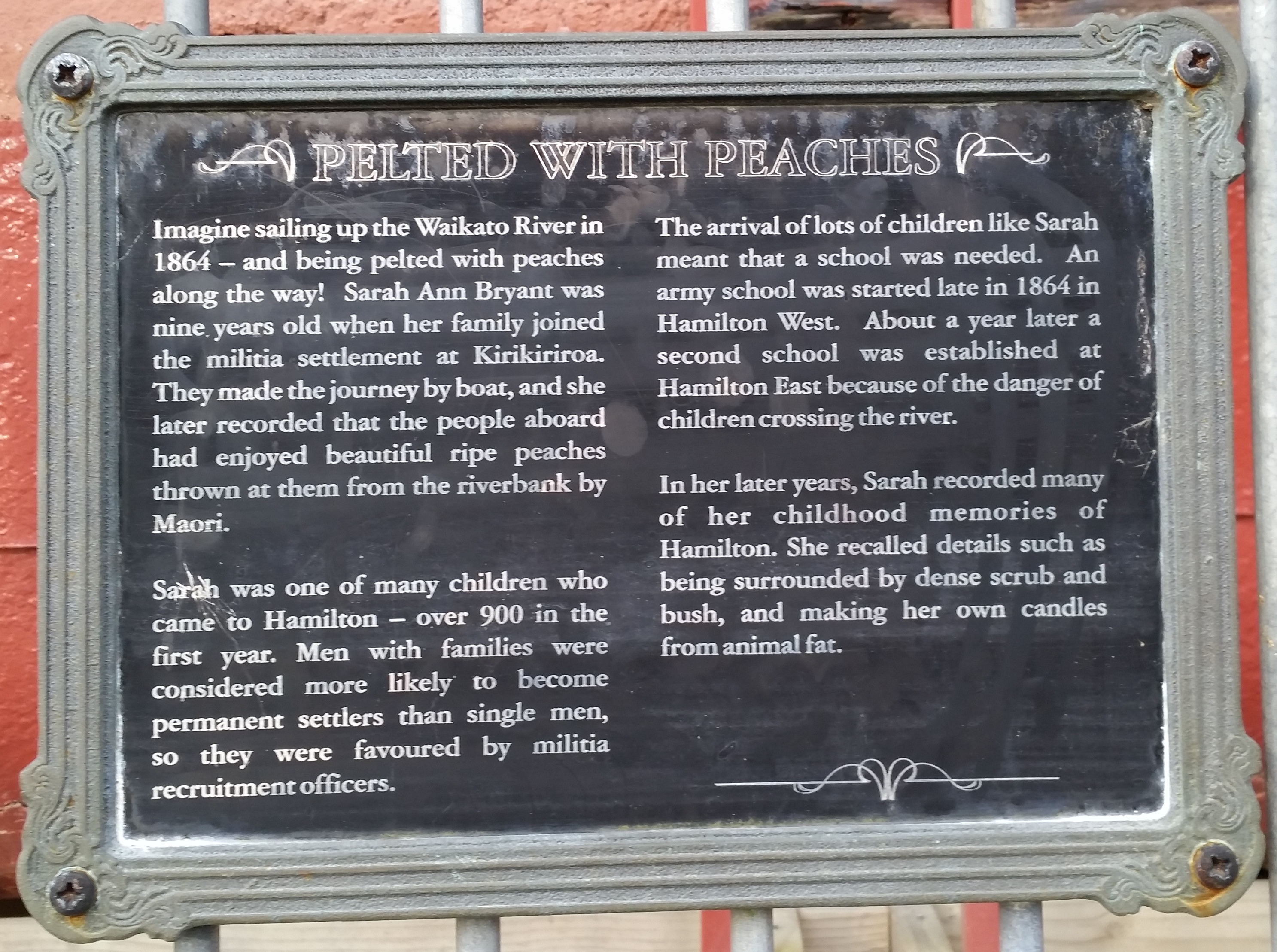
Acknowledgement of the Waikato Wars is 4th of those recognised and is represented by Captain William Steele’s gunboat Rangiriri that claimed the territory after the defeat of Kīngitanga fighters in the 1863 Rangiriri battle.
The monument classifies the “iron hulk” as a “paddle steamer” that “had no guns,” was “too late to engage in hostilities” and “spent her life transporting goods and people”.
Differing views exist regarding the purpose and perception of such vessels following the events of the 1860s wars.
See also A new view of the past


